Adaptive Vs Hybrid ANC for Earbuds

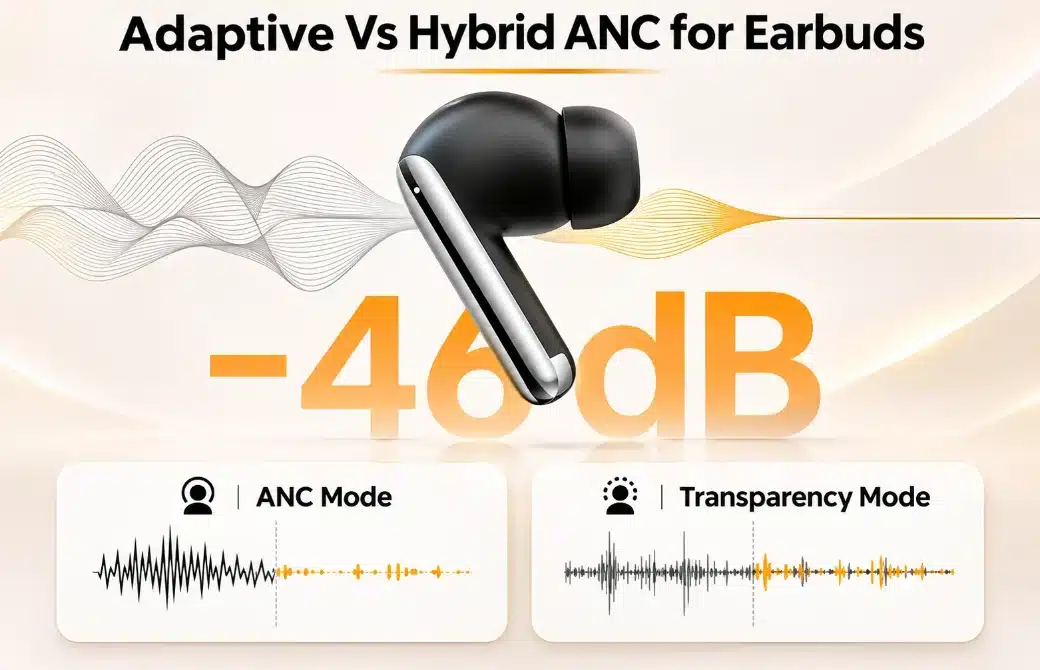
Two earbuds claim to offer ANC, yet their performance can feel surprisingly different. The reason often hides behind the ANC technologies they use: Adaptive and Hybrid. One constantly adjusts for cancellation based on surroundings. But the other one uses multiple microphones to detect and reduce external noise more effectively.
But here’s the catch: you can’t easily pick one winner. Your daily environment, listening habits, and even ear-tip fit can make the difference. So which one works best? Today, we’ll break down Adaptive and Hybrid ANC in simple terms. We’ll compare their strengths and weaknesses and help you choose the right option.
What Is ANC in Earbuds?
ANC stands for Active Noise Cancellation, a technology that reduces unwanted background sounds. Unlike regular passive noise isolation, ANC in earbuds actively works against external noise. Tiny built-in microphones listen to sounds around you. Then, a small computer chip analyzes that noise and creates an opposite sound wave. Sound can be anything, such as traffic, airplane engines, fans, or people talking. This opposite wave helps cancel out noise before it reaches your ears.
What Is Hybrid ANC in Earbuds?
Hybrid ANC takes noise cancellation further. This tech uses both external feedforward and internal feedback microphones. These microphones listen to noise outside and inside your ear at the same time. A smart chip then processes these sounds and creates an opposite sound wave to cancel them.
As a result, Hybrid ANC can handle a wide range of sounds. It can deliver a much quieter listening experience, particularly in busy places. Notably, it performs well even when the earbuds do not fit perfectly. Despite these benefits, Hybrid ANC usually costs more to build and uses more battery power. The following are some earbuds offering Hybrid ANC:
What Is Adaptive ANC in Earbuds?
Adaptive ANC makes noise cancellation more responsive to your surroundings. It uses built-in microphones and processors to sense your environment. After that, AI optimization automatically changes the noise-blocking strength in real time. When you move from a noisy street to a quiet room, the earbuds automatically adjust ANC intensity.
Two key features make this possible:
- Real-Time Monitoring continuously monitors ambient noise
- Automatic Scaling adjusts ANC strength as conditions change
Hands-free convenience is particularly useful for travelers. However, the software algorithm may lag when noise changes suddenly, causing slight volume shifts. Here are some earbuds offering adaptive ANC:
Adaptive ANC vs Hybrid ANC: Key Differences
| Key Difference | Adaptive ANC | Hybrid ANC |
| Technology | Adjusts noise cancellation automatically | Uses both feedforward and feedback ANC |
| Hardware vs Intelligence | Relies more on smart algorithms and real-time processing | Relies more on a dual-microphone hardware setup |
| Noise Detection | Continuously monitors surrounding noise and adjusts accordingly | Detects noise both outside and inside the ear |
| Sound Spectrum | Adapts cancellation to changing noise conditions | Handles a wider range, including low hums and higher-pitched sounds |
| Real-Time Adjustment | Automatically increases or decreases ANC strength | Usually provides fixed or preset ANC levels |
| Noise Cancellation Performance | Particularly effective when noise levels change frequently | Generally offers strong and consistent noise cancellation |
| Battery Consumption | Use less power due to adjustments | Use more power because of multiple microphones and ANC processing |
| Comfort & Listening Experience | Feel more natural in quiet places because ANC intensity drops | Consistent quieter listening, but may feel stronger in some environments |
Adaptive ANC or Hybrid ANC: Which Is Better for Bangladeshi Users?
The best choice depends on where and how you use your TWS earbuds. In Bangladesh, busy roads, crowded buses, office noise, and frequent travel can all affect your choice.
Here’s a quick guide:
- For Travel & Flight: Hybrid ANC is the better choice. It handles steady engine noise and a wide range of sounds, making long flights more comfortable.
- For Commuting: Adaptive ANC works well for changing noise levels. It can adjust as you move between quiet streets, busy roads, and public transport.
- For Office Use: Adaptive ANC is a smart choice. It can lower ANC in quieter areas and increase it when fans, conversations, or other noise become stronger.
- For Gaming: Hybrid ANC is recommended for strong noise isolation during gaming. It reduces background distractions during a match.
- For Music & Entertainment: Hybrid ANC offers a consistently quiet environment. This can help you enjoy music and videos without raising the volume too much.
- For Noisy Environments: Hybrid ANC generally wins. Its external and internal microphones can handle a broad range of unwanted sounds.
Common Mistakes When Choosing ANC Earbuds
Good ANC is not only about stronger noise cancellation. Many buyers focus on a single feature and overlook other factors that affect the real-world experience. Avoid these common mistakes:
- Higher ANC Numbers Mean Better Performance: Myth! ANC figures do not tell the whole story. Microphone quality, tuning, algorithms, and fit also affect performance.
- Ignoring Ear-Tip Fit and Passive Isolation: Even strong ANC can struggle with poor fit. Choose the right ear-tip size for a better seal and improved noise reduction.
- Focusing Only on ANC Type: Adaptive or Hybrid ANC alone does not make TWS earbuds better. Check sound quality, battery life, comfort, call quality, and overall performance too.
- Overlooking Transparency Mode and Microphone Quality: A good transparency mode helps you hear people and traffic without removing your earbuds. Quality microphones also matter for clearer calls, particularly in noisy places.