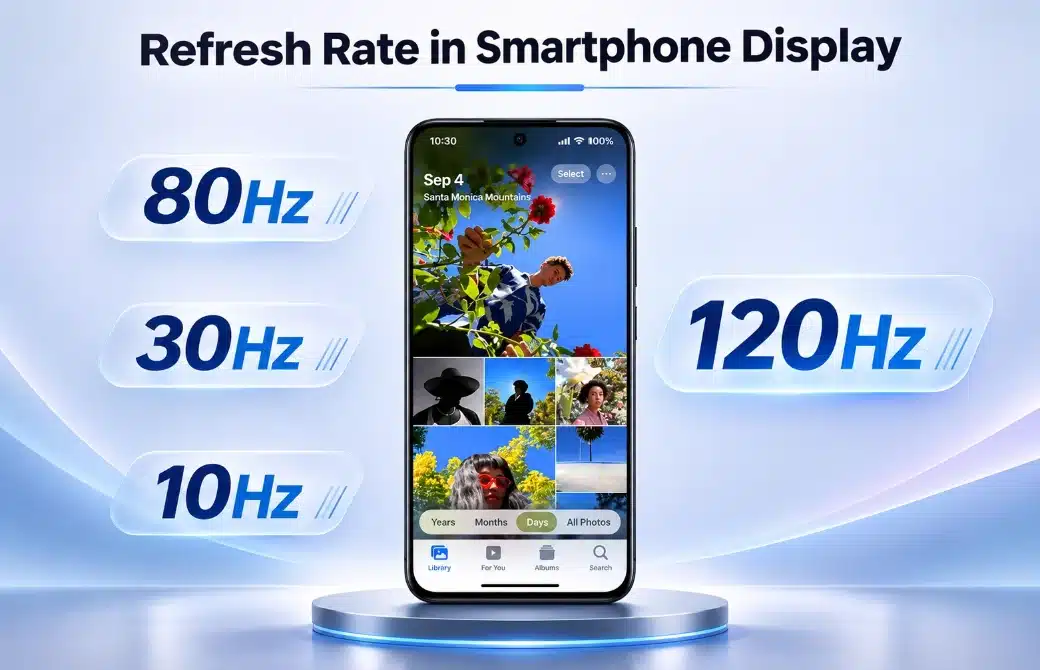
Refresh Rate in Smartphone Display

Higher-refresh-rate displays are now a major selling point for modern smartphones. But manufacturers are pushing the limits even further with 144Hz, 165Hz, and even 185Hz screens. Notably, some tablets, such as the HONOR WIN Tablet, offer up to 240Hz refresh rates.
Companies promote these high numbers to make their devices stand out from the competition. But what do they actually mean for users? Even though, higher refresh rates can provide several noticeable benefits. However, you may not be able to address all your concerns with those benefits.
So, does a high refresh rate really matter for everyday smartphone use? Let’s explore how refresh rates work on your smartphone, along with their benefits and drawbacks. Also, we will discuss which option makes the most sense when buying your next smartphone.
What is the refresh rate of a smartphone display?
Every time you scroll, swipe, or watch a video, your smartphone display refreshes its content to show the latest information. This process is known as the refresh rate. Measured in Hertz (Hz), it tells you how often a screen updates its image per second. For example, a 60Hz display refreshes 60 times per second (meaning that every 16.6 milliseconds, a new frame is sent to the panel). Meanwhile, a 120Hz display does it 120 times per second.
Importantly, a smartphone screen doesn’t update all its pixels at once. Instead, it refreshes each horizontal row of pixels until the entire image is updated.
Here are the key points to understand:
- Higher refresh rate: Updates the screen more frequently, making scrolling and animations smoother.
- Lower refresh rate: Uses fewer screen updates per second, conserving battery power.
- Measured in Hz: A higher Hz number means the display can refresh more times each second.
Simply put, refresh rate determines how smoothly your smartphone displays moving content, from scrolling through social media to playing games.
Different refresh rates are available on smartphones
Smartphones now offer a wide range of refresh rates. They range from the traditional 60Hz up to 185Hz. Each level offers a different visual experience. Notably, higher refresh rates make scrolling, animations, and supported games look smoother.
Here are the most common refresh rates, along with some popular smartphone examples.
60Hz Refresh Rate
60Hz has been the standard refresh rate on smartphones for years. It means the display refreshes its content 60 times per second. It works well for everyday activities like calling, messaging, browsing, and watching videos. However, scrolling and animations may look less fluid than on higher-refresh-rate screens. One of the most popular devices is the Apple iPhone 16, which features a 60Hz display.
90Hz Refresh Rate
A 90Hz display refreshes its content 90 times per second. It offers a noticeable improvement over 60Hz. This is particularly true when scrolling through social media or browsing websites. It also provides a good balance between smooth visuals and battery consumption. The most popular smartphone is Google Pixel 7a, which comes with a vivid 90Hz OLED display.
120Hz Refresh Rate
120Hz has become a popular choice for modern mid-range and flagship smartphones. It refreshes the screen 120 times per second. This makes scrolling, animations, and supported games noticeably smoother. It also offers a more responsive visual experience for everyday use. Most popular budget-to-mid-range devices now come with 120Hz panel. However, some popular models are Samsung Galaxy A57, Galaxy M47, Xiaomi POCO X8, Motorola Edge 60 Fusion, and many more.
144Hz Refresh Rate
144Hz takes display smoothness a step further. It refreshes the screen 144 times per second. This offers smoother motion during fast-paced gaming and animations. However, the difference from 120Hz is relatively small in everyday use. Competitive gamers may appreciate the additional smoothness. Some popular devices include Motorola Edge 70 Pro, vivo V80, and Xiaomi 17T Pro. This particular refresh rate is primarily found on gaming-focused and media-consuming devices.
165Hz Refresh Rate
165Hz displays are particularly popular in gaming-focused and performance-oriented smartphones. They can refresh the screen 165 times per second. This allows compatible games to deliver smoother motion and a more fluid gaming experience. OnePlus 15R, Xiaomi Redmi K100, Motorola Razr 60 Ultra, or vivo iQOO 16 are some of the popular devices that come with this panel.
185Hz Refresh Rate
185Hz is among the higher refresh rates available on modern smartphones. It allows the display to refresh up to 185 times per second. This can provide an advantage in supported high-frame-rate games. However, most everyday users may notice only a small difference compared to 120Hz or 144Hz. You can check HONOR Win2 RT, OnePlus 16, Xiaomi Poco F9 Ultra, OnePlus Ace 7 Pro, ZTE nubia RedMagic 12 Pro+ to experience this.
Advantages of High Refresh Rates on Smartphones
A high refresh rate does more than make a smartphone display look good on paper. It can noticeably improve how you interact with your phone throughout the day. Here are the key advantages:
Smoother Scrolling and Animations
Higher refresh rates make screen movements look more fluid. Whether you’re scrolling through
- Browsing websites, or
- Switching between apps
Animations appear smoother with fewer visible motion jumps. This makes everyday navigation feel more natural.
Enhanced Gaming Experience
High-refresh-rate displays can make compatible games look smoother, particularly during fast movement. For example, games supported at 120FPS can take advantage of a 120Hz screen to deliver more fluid gameplay. Particularly useful in competitive games where quick reactions matter.
Better Motion Clarity
More refresh rates mean more frequent screen updates. As a result, fast-moving objects can appear smoother and easier to follow. When playing fast-paced games or watching high-frame-rate videos, these higher refresh rates provide more clarity on motion. However, actual motion clarity also depends on pixel response time and content frame rate.
More Responsive Visual Experience
A higher refresh rate reduces the time between screen updates. This can make animations and visual feedback feel quicker when you interact with your smartphone. However, actual touch responsiveness also depends on touch sampling rate and system performance.
Better Experience With High-FPS Content
Videos and games recorded or rendered at higher frame rates can take better advantage of high-refresh-rate displays. For instance, a 120Hz screen can display compatible 120FPS content without skipping or repeating frames. Notably, the most noticeable improvement occurs when you move from 60Hz to 90Hz or 120Hz. Beyond that, the difference becomes smaller for most everyday users.
Limitations of High Refresh Rates
Even though high refresh rates provide smoother visuals and a better gaming experience. Fixed high-refresh-rate displays have one notable drawback! And that is higher battery consumption.
A 120Hz or 144Hz screen needs to refresh its content more frequently than a standard 60Hz display. This can increase power usage, particularly when you keep the phone running at its maximum refresh rate throughout the day. As a result, you may need to charge your smartphone more often.
Here are the key disadvantages to consider:
- Higher Battery Consumption: Higher refresh rates can use more power, reducing screen-on time. The actual impact depends on the display panel, brightness, processor, and usage.
- Limited Benefits in Some Activities: Watching standard 30FPS or 60FPS videos won’t always take full advantage of a 120Hz or 144Hz display. So, you may not notice much improvement in every activity.
- Higher Smartphone Cost: Advanced display technologies, particularly LTPO panels, can increase manufacturing costs. This may make smartphones with adaptive high-refresh-rate displays more expensive.
- More GPU Workload: Running supported games at higher frame rates requires more GPU processing. This can increase power consumption and heat during demanding gaming sessions.
To minimize these drawbacks, manufacturers invented a technology called LTPO. This Low-Temperature Polycrystalline Oxide (LTPO) technology helps reduce unnecessary power consumption. It allows compatible displays to dynamically adjust their refresh rates.
This allows the panel to reduce the refresh rate to as low as 1Hz when idle. However, when you apply a load to the panel again, it jumps back to its maximum capacity. This variable refresh rate (VRR) can save up to 15% battery without sacrificing smooth visuals. However, LTPO displays can increase a smartphone’s overall cost. Also, the actual power savings vary by device and usage.
What refresh rate is best for daily use?
For most smartphone users, 120Hz is the sweet spot for daily use. 120Hz provides a smoother experience, particularly when browsing social media or playing supported games. If you mainly use your phone for calling, messaging, and watching videos, 60Hz is still sufficient. Notably, an adaptive refresh rate can offer a better balance between visual smoothness and battery life.