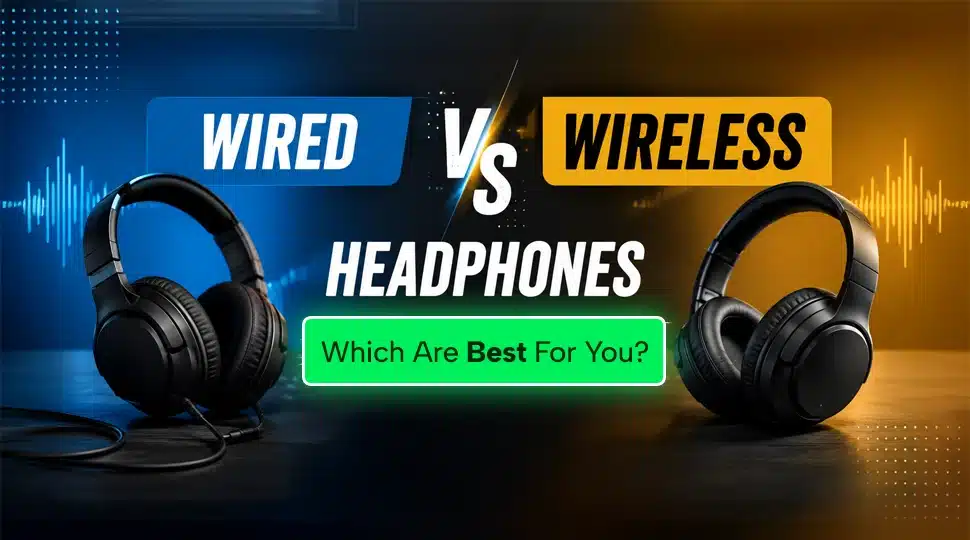
Wired vs Wireless Headphones: Which Are Best For You?

Introduction
Choosing a pair of headphones isn’t as straightforward as it used to be. The clean boundary that once separated high-fidelity wired studio gear from convenient, portable wireless setups has completely blurred.
Thanks to the introduction of Bluetooth 5.4 and LE Audio, wireless gear is no longer the underdog. Cutting-edge codecs like LC3 and aptX Lossless now deliver near CD-quality audio across the airwaves with none of the old-school compression artifacts. At the same time, the complete disappearance of the 3.5mm analog jack from modern flagship smartphones means that choosing wired audio now requires dealing with Type-C digital connections, external dongles, or portable DACs (Digital-to-Analog Converters).
With uncompressed, lossless streaming now standard on platforms like Apple Music and Amazon Music, mobile gaming hits at an all-time high, and advanced Active Noise Cancellation (ANC) serving as a mandatory survival tool for noisy daily commutes and hybrid office spaces, your choice of headphone style dictates your entire daily routine. Whether you are a competitive FPS gamer, a professional video editor, or someone looking to block out office distractions, this guide breaks down the technical realities of wired vs wireless headphones to help you pick your perfect match.
Wired vs Wireless Headphones: Quick Answer
Wireless headphones are the better choice for most everyday users, travelers, and gym-goers because they provide total physical freedom, excellent Active Noise Cancellation (ANC), and seamless smart features. However, wired headphones remain superior for raw sound quality, zero-latency performance, lifelong hardware durability, and pure value for your money.
Wired headphones receive an uncompressed analog signal, meaning your music remains completely pure without lossy compression or wireless bandwidth caps. They also feature zero input lag, making them mandatory for gaming or studio work. Wireless headphones prioritize convenience—using internal batteries to power onboard processing chips, amplifiers, and noise-canceling hardware while receiving compressed digital files over the air.
Quick Verdict
Buy Wired If:
- You want the absolute highest sound resolution possible for every dollar spent.
- You play competitive games where even a split-second audio delay can ruin the match.
- You work in video production, edit audio, or record podcasts.
- You hate the anxiety of low-battery warnings, charging bricks, and occasional Bluetooth drops.
Buy Wireless If:
- You commute on public transit, fly often, or share a loud, open-plan office space.
- You view Active Noise Cancellation (ANC) and Ambient/Transparency modes as non-negotiable.
- You stream audio while running, lifting weights, or cleaning the house.
- Your primary devices lack a native headphone jack and you refuse to carry a physical dongle.
Wired vs Wireless Headphones at a Glance
| Feature | Wired Headphones | Wireless Headphones |
|---|---|---|
| Audio Compression | Uncompressed / Bit-Perfect | Compressed (Lossy to Near-Lossless) |
| Latency / Delay | Zero Latency (0–5 ms) | Variable Latency (40–200 ms) |
| Power Source | Device Powered (No charging needed) | Internal Battery (Requires regular charging) |
| Lifespan | Long (5–10+ Years; no battery to degrade) | Medium (2–5 Years; battery degrades over time) |
| Active Noise Cancelling | Extremely Rare | Industry Standard on Mid-to-High Tiers |
| Physical Weight | Lighter (No internal electronics or battery) | Heavier (Due to onboard batteries and chips) |
What Are Wired Headphones?
Wired headphones receive their audio signals as a continuous analog wave directly through a physical cable. This cable typically terminates in a 3.5mm TRS/TRRS jack, a 6.35mm studio plug, or a direct digital USB-C connector.
Because they rely entirely on external power and signals sent from your phone, laptop, or dedicated player, they do not require internal processing chips, internal digital-to-analog converters, or batteries. They operate as direct transducers, converting electrical energy into mechanical acoustic energy through their internal dynamic, planar magnetic, or electrostatic drivers.
What Are Wireless Headphones?
Wireless headphones use built-in radio antennas to receive compressed digital data over the air, primarily utilizing the Bluetooth wireless protocol. Because smartphones and computers output digital files, wireless headphones must do the heavy lifting internally.
Every wireless headphone features an onboard Bluetooth receiver chip, an internal DAC to decode the wireless packet data, an internal amplifier to power the drivers, and a lithium-ion battery to keep the whole system running. Modern options also feature digital signal processors (DSPs) to handle custom equalization, active noise cancellation calculations, and microphone noise isolation.
Sound Quality Comparison
When it comes to pure audio detail and resolution, wired headphones win by a wide margin.
A wired cable provides a massive, uninterrupted pipeline for data. When you play a high-resolution, lossless audio file (like a 24-bit/192kHz FLAC), a wired connection transfers that data directly to the headphone drivers with zero alteration. The preservation of instrument separation, soundstage depth, and minute micro-details is absolute.
Wireless audio, by contrast, is bottlenecked by open-air bandwidth constraints. To send an audio file over Bluetooth, your source device must first compress the file using a specific audio codec. Standard codecs like SBC and Apple’s preferred AAC discard data to keep the packet size small, resulting in compressed, flatter sound profiles.
Even advanced, high-resolution wireless codecs like Sony’s LDAC (up to 990kbps) or Qualcomm’s aptX Lossless scale down dynamically if you move into areas with heavy radio frequency interference. Furthermore, because wireless headphones rely on small, inexpensive internal DAC chips and amplifiers crammed into the ear cups alongside a battery, their acoustic output can rarely match the power and clean performance of a dedicated external desktop or portable DAC setup used with wired gear.
Technical Performance Metrics
Comfort & Design
Wired headphones are fundamentally lighter because they do not carry the structural weight of lithium-ion batteries or circuit boards. This makes long-term listening sessions much easier on your neck and head ridge. However, you have to contend with cable management, microphonics (the annoying sound of the wire rubbing against your shirt), and physical desk entanglement.
Wireless headphones offer unmatched physical freedom—there is no wire to snag on doorknobs or pull your phone off a desk. The trade-off is higher overall physical weight, which requires manufacturers to use tighter headband clamping forces to keep the headphones secure on your ears.
Battery Life
Wired headphones have zero battery restrictions. They draw tiny amounts of milliwatt power directly from your source device’s audio port, meaning they can play indefinitely.
Wireless over-ear headphones in 2026 generally offer between 30 to 60 hours of continuous playback backup per charge, while True Wireless Stereo (TWS) earbuds provide 6 to 10 hours before needing to sit back in their charging cases. Once the non-replaceable internal lithium batteries inevitably degrade after 300 to 500 charge cycles, the entire wireless unit effectively hits its end-of-life status.
Noise Cancellation
If you want deep silence during travel, wireless is your only real choice. Active Noise Cancellation (ANC) requires integrated exterior microphones to analyze outside ambient noise waves, alongside an onboard digital processor to generate inverse “anti-noise” waves to cancel them out.
Because this system requires dedicated power, ANC is built directly into wireless headphone ecosystems. While a few wired options offer passive isolation via tight-fitting ear cups or custom ear tips, they cannot eliminate low-frequency engine drones or office air conditioning hums the way modern smart ANC wireless headphones do.
Gaming Performance
For serious gaming, wired remains the undisputed gold standard. Wired connections have an inherent latency of less than 5 milliseconds, meaning the sound of an enemy footprint or a gunshot reaches your ears instantly.
Wireless Bluetooth headphones suffer from noticeable input lag. Traditional Bluetooth connections can introduce 150 to 250 milliseconds of delay, causing a jarring disconnect between what you see on screen and what you hear.
While Bluetooth 5.4 LE Audio with the LC3 codec or specialized 2.4GHz USB wireless dongles cut lag down to a respectable 30 to 40 milliseconds, competitive players on PC, Console, or Mobile still prefer wired gear to ensure perfectly synchronized directional audio cues.
Device & Daily Compatibility
Phone Compatibility
The modern hardware landscape makes compatibility a bit complicated. Most modern flagship smartphones completely lack a native 3.5mm headphone jack. To use classic wired headphones, you must buy and carry a USB-C or Lightning dongle DAC, or switch entirely to headphones that native-terminate in a digital USB-C connector.
Wireless headphones connect easily via Bluetooth to almost any smartphone, tablet, or laptop. Premium wireless sets also feature Bluetooth Multipoint, letting you connect to both your work laptop and personal smartphone simultaneously, seamlessly switching audio streams when an incoming call comes through.
-
Avoid Generic Dongles: If you want to use high-end wired headphones with a modern USB-C smartphone, avoid cheap, unbranded plastic adapters.
-
Invest in a Dedicated Dongle DAC: Choose an affordable, high-quality USB-C Dongle DAC instead—specifically ones featuring reliable chips like the CS43131 or ESS Sabre.
-
Better Sound & Power: A dedicated DAC significantly improves audio amplification and clears up background hiss.
-
Unlock High-Res Audio: It allows your phone to fully decode and output high-res, lossless streaming formats without bottlenecking the quality.
Durability & Repairability
Wired headphones are incredibly durable. With no internal batteries to wear down and no digital chips to brick via software updates, a well-made pair of wired open-back or closed-back studio headphones can easily last over a decade. If the cable snaps or gets chewed by a pet, most intermediate-to-premium wired models allow you to simply unplug the broken cable and pop in a cheap replacement.
Wireless headphones have a built-in expiration date. Their lithium batteries degrade every year, their internal firmware can lose software support, and their highly integrated circuit designs make self-repair almost impossible for the average consumer.
Microphone Quality
Wired headphones handle voice communication beautifully. An inline cable microphone or a attachable boom mic sends an uncompressed, analog voice signal straight down the line.
Wireless headphones must compress your microphone input down to low-bandwidth voice profiles (like HFP) to transmit it back via Bluetooth, which often results in a muffled, compressed “walkie-talkie” vocal quality during zoom calls or cellular voice chats, despite advanced AI noise reduction algorithms.
Real-World Use Cases
Travel & Daily Commuting
Wireless headphones dominate travel. Dealing with a tangled wire while pulling luggage through an airport or navigating a crowded public bus is incredibly frustrating. Wireless transparency modes also let you hear gate announcements or traffic changes instantly without pulling your headphones off your head.
Gym & Intense Workouts
Wired headphones are a massive hazard at the gym; a single accidental arm swing can yank your phone off a treadmill or violently rip earbuds out of your ears. Wireless earbuds or sweat-resistant headphones with secure clamping fits provide total movement freedom for lifting weights, running, or calisthenics.
Office & Professional Workspaces
For office video calls and desks, wireless multipoint headphones let you stretch, grab a coffee, or stretch your legs while staying locked into a long meeting presentation. However, if your job involves audio editing, professional podcast recording, or streaming on platforms like Twitch, you must use wired headphones to prevent video-to-audio sync drifts and capture clean mic inputs.
Financial Breakdown & Pros & Cons
Price vs Value Realities
Wired headphones provide massive value for money. When you buy a $50 wired headphone, 100% of the manufacturing budget goes directly into the acoustic drivers, structural comfort, and tuning.
When you buy a $50 wireless headphone, that same budget must be divided across a Bluetooth chip, an internal battery, internal DAC/Amp chips, mic modules, and software licensing fees—leaving very little room for high-quality acoustic materials. Consequently, a budget wired headphone will easily outperform a wireless headphone that costs two to three times as much.
Pros & Cons: Wired Headphone
| PROS | CONS |
|---|---|
| Pristine, uncompressed audio fidelity | Annoying physical cable tangling |
| Absolute zero audio latency or lag | Requires adapters on many modern smartphones |
| Infinite runtime; no battery charging required | Lacks smart software features and companion EQ apps |
| Long operational lifespan (typically 5–10+ years) | Very few wired models offer true Active Noise Cancelling (ANC) |
Pros & Cons: Wireless Headphones
| PROS | CONS |
|---|---|
| Total physical freedom; no cables | Audio quality is compressed via lossy Bluetooth codecs |
| Advanced Active Noise Cancelling (ANC) | Internal battery degrades over time |
| Multipoint pairing between devices | Noticeable latency in fast-paced gaming |
| Integrated voice assistants & touch controls | Higher cost for comparable sound quality |
How to Choose the Right Headphones
When navigating the market, prioritize these core purchasing factors:
- Your Primary Use Case: If your headphones rarely leave your desk or gaming chair, go wired. If you are constantly on the move, commuting, or traveling, go wireless.
- Budget Allocation: If you have less than $50 to spend, look at wired options or simple neckbands. Avoid ultra-cheap wireless over-ear headphones, as their build quality and sound tuning are rarely up to par.
- Codec Check (For Wireless): If you are buying wireless, make sure the headphones match your phone’s capabilities. iPhone users need excellent AAC optimization. Android users should look for LDAC or aptX Adaptive/Lossless to ensure high-bitrate streaming.
- Weight & Clamping Force: Check the specifications for physical weight. For long-term 8-hour office days, look for over-ear headphones weighing under 260 grams to avoid head fatigue.
Best Fit Matrix & Price Focus
User Match Matrix
| Target User | Recommended Type | Primary Reason |
|---|---|---|
| Student | Wireless Over-Ear (Mid-range) | Portability across campus with Active Noise Cancelling (ANC) for focused study. |
| Office Worker | Wireless with Multipoint | Switch seamlessly between laptop meetings and smartphone calls. |
| Traveler | Flagship Wireless ANC | Reduces loud airplane engine noise for a more comfortable journey. |
| Gamer | Wired (3.5 mm or USB) | Delivers near-zero latency for accurate in-game audio positioning. |
| Audiophile | Wired Open-Back | Provides uncompressed audio quality with a wide, natural soundstage. |
| Video Editor | Wired Closed-Back | Ensures perfect audio synchronization during editing and monitoring. |
2026 Price Tier Breakdown
| Price Range | Target Buyer | Key Expected Features | Real-World Performance & Examples |
|---|---|---|---|
| Up to 3,000 BDT | Budget Students / Casual Users | • Basic 3.5 mm wired headphones • SBC Bluetooth neckbands • Simple plug-and-play design |
Good audio quality from wired IEMs such as Tangzu Wan’er and 7Hz Salnotes Zero. Most wireless options in this range prioritize affordability over premium sound. |
| 3,500–7,000 BDT | Value Seekers / Daily Commuters | • Entry-level ANC • USB-C charging • Basic EQ app support |
Anker Soundcore Q20i delivers reliable ANC and excellent value. This is also a strong price tier for entry-level audiophile wired headphones. |
| 7,000–12,000 BDT | Hybrid Workers / Mobile Gamers | • Bluetooth 5.4 • AAC / LDAC support • 40+ hour battery life |
Moondrop Aria remains an outstanding wired choice for sound quality, while quality TWS models from realme and Xiaomi offer excellent everyday performance. |
| 12,000–24,000 BDT | Content Creators / Frequent Flyers | • Hybrid Adaptive ANC • Multipoint connectivity • Hi-Res Audio certification |
Excellent options include the Soundcore Space One Pro and the wired benchmark Audio-Technica ATH-M50x. |
| 24,000+ BDT | Audiophiles / Premium Travelers | • Flagship ANC • aptX Lossless support • Premium materials & DSP tuning |
Premium choices include Sony WH-1000XM6, Bose QuietComfort Ultra, Sennheiser Momentum 5, and the wired HiFiMan Sundara. |
Common Buyer Mistakes
- Buying Solely by Brand Name: Assuming a $300 wireless headphone sounds better than a $100 wired studio headphone from an audio-first brand is a mistake. You are often paying a premium for marketing and lifestyle aesthetics rather than raw acoustic engineering.
- Ignoring Wireless Audio Codecs: Buying a premium flagship LDAC wireless headphone to use exclusively with an iPhone (which caps wireless output at standard AAC) wastes the high-bitrate potential of the hardware.
- Overlooking Long-Term Comfort: Buying headphones based purely on online sound reviews without checking the physical weight or ear cup padding can lead to severe ear pinching and head ridge soreness within an hour of use.
- Forgetting Latency Constraints: Buying high-end Bluetooth headphones expecting to play competitive online multiplayer shooters like PUBG Mobile or Call of Duty will lead to frustration due to the inherent audio delay.
Expert Recommendations
Best Overall Wireless: Sony WH-1000XM6
- Why: It offers an incredible blend of industry-leading active noise cancellation, smart adaptive software features, superb long-term comfort, and high-resolution LDAC codec support for Android users.
Best Value Audiophile Wired: Sennheiser HD 560S / Moondrop Chu II (IEM)
- Why: The HD 560S provides an incredibly wide, natural soundstage and clinical frequency response that allows you to hear individual mix elements clearly, outclassing wireless options that cost four times as much.
Best Budget Wireless ANC: Anker Soundcore Q20i
- Why: For under $40, it delivers surprisingly competent ambient noise reduction, a comfortable over-ear fit, and an impressive 40-hour battery life, making it an easy recommendation for students.
Best Competitive Gaming: Beyerdynamic DT 990 Pro (Wired)
- Why: The open-back design and sharp treble extension provide exceptional pin-point directional spatial awareness, allowing you to track enemy footsteps instantly with absolute zero lag.
Frequently Asked Questions (FAQ)
Are wired headphones healthier or safer than wireless options?
Both options are entirely safe. Wireless headphones emit non-ionizing RF (Radio Frequency) radiation at incredibly low power levels that fall well within strict international safety guidelines. There is no verified scientific evidence showing Bluetooth headphones pose any health risks.
Do wireless headphones always cause audio delay?
Yes, all wireless Bluetooth devices introduce some degree of latency due to the time required to encode, transmit, and decode digital audio packets. While modern Bluetooth 5.4 chips and low-latency gaming modes drop this down to an unnoticeable level for movies, it can still be felt in competitive fast-paced gaming.
Can wireless Bluetooth headphones be used with a wire?
Yes, many mid-range and premium wireless over-ear headphones include a 3.5mm auxiliary port or a data-capable USB-C port, allowing you to plug them in directly when the battery dies or when you need a zero-latency connection.
Do wireless headphones lose sound quality over time?
The audio drivers themselves do not lose quality, but the overall performance can drop as the internal lithium-ion battery degrades, which limits amplification power or prevents the headphones from holding a charge.
Can wired headphones work perfectly with modern USB-C phones?
Yes. You can use a simple, low-cost USB-C to 3.5mm dongle adapter. For better performance, buying a small portable USB Dongle DAC will ensure pristine digital-to-analog conversion and higher volume ceilings.
Are expensive wireless headphones really worth the high price tag?
They are worth it if you highly prioritize top-tier Active Noise Cancellation, wireless device switching, and premium travel comfort. If your only priority is pure music sound quality, your money is much better spent on a mid-range wired setup.
Can Active Noise Cancellation (ANC) work without playing any music?
Yes. You can turn on most wireless ANC headphones, activate noise cancellation, and wear them without streaming any audio to block out ambient office chatter or deep airplane cabin drone while sleeping.
Final Verdict
The choice between wired and wireless headphones comes down to your physical environment and daily workflow priorities.
- If your priority is absolute convenience, travel freedom, and peace of mind during noisy commutes, buy wireless headphones. The advanced ANC tech, lack of tangled cables, and smart software features in modern options make them an invaluable tool for modern mobile life.
- If your priority is pure sound quality, competitive gaming performance, studio editing, or long-term product durability, buy wired headphones. They offer uncompressed audio fidelity, absolute zero lag, and will outlive multiple generations of wireless gear without ever needing to be plugged into a wall charger.