Samsung Exynos vs Snapdragon Processors

You’ve probably heard people say, “Never buy an Exynos Samsung.” But is that still true in 2026? The answer might surprise you because Samsung’s latest Exynos chips have closed much of the gap in performance.
That doesn’t mean every Exynos processor is identical to its Snapdragon counterpart. Each chipset has its pros and cons, and which one is better really comes down to how you use your phone. The processor inside your device can make a real difference if you care most about gaming, battery life, camera performance, multitasking, or long-term efficiency.
In this Exynos vs. Snapdragon comparison, we will look beyond the marketing claims and compare real-world performance, gaming capabilities, thermal management, battery efficiency, AI features, and connectivity. You’ll be able to see which processor is better for you and if it’s actually worth paying extra for a Samsung phone with a Snapdragon.
What Are Exynos and Snapdragon Processors?
But before we get into performance, it is important to know what these two processors are and why they are important when picking a Samsung smartphone.
The processor (often referred to as the chipset, or system-on-chip, SoC) is what runs just about everything your smartphone does. Great for everyday use like launching apps, web browsing, taking pictures, gaming, multitasking, and battery efficiency. A faster, more powerful processor can help make your phone feel more fluid, extend battery life, and improve gaming and camera performance.
Exynos
Exynos is a series of SoC processors developed by Samsung Semiconductor. These chipsets can be found in most Galaxy smartphones and tablets. Over the years, Samsung has improved the performance of Exynos chips by improving the CPU. performance, graphics performance, AI processing, and power efficiency so that they can compete better with other flagship chipsets.
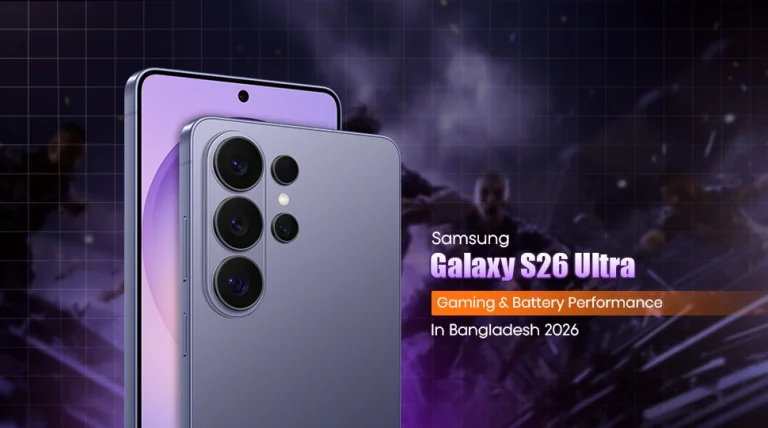
For example : Samsung Galaxy S26
Snapdragon
However, Snapdragon is made by Qualcomm and appears on phones from a variety of Android brands like Samsung, Xiaomi, OnePlus, ASUS, and Motorola. Fans of smartphones love Snapdragon processors because of their reputation for great gaming performance, efficient power consumption, and reliable 5G connectivity.
One thing that confuses buyers a lot is why Samsung sometimes releases the same Galaxy phone with different processors. The answer usually depends on regional availability, supply chain planning, manufacturing capacity, modem compatibility, and business strategy, he said. For example, a Galaxy flagship sold in one country might use a Snapdragon processor, and the same model in another country could use an Exynos chip. Both versions share the same design, the display, the cameras, and the software experience, but the performance, battery life, and thermal behavior can be slightly different depending on the chipset inside.
For instance: Samsung Galaxy S26 Ultra
Exynos vs Snapdragon at a Glance
| Feature | Samsung Exynos | Qualcomm Snapdragon |
| 1. Sustained Performance | Strong performance with significant improvements in recent flagship generations. Under prolonged heavy workloads, performance may reduce sooner depending on the device’s cooling system. | Generally delivers more consistent, sustained performance during long gaming sessions, video rendering, and other intensive tasks with less throttling. |
| 2. Build Architecture | Uses ARM CPU cores paired with Samsung’s custom optimizations. Recent flagship chips adopt advanced 3nm/4nm manufacturing processes and Xclipse GPUs based on AMD RDNA architecture. | Also built on ARM CPU cores with Qualcomm’s custom optimizations. Uses advanced fabrication nodes (3nm/4nm) alongside Adreno GPUs, known for strong graphics efficiency. |
| 3. NPU (AI) Performance | Dedicated NPU accelerates Galaxy AI features, image enhancement, voice recognition, and on-device AI tasks. AI performance has improved considerably in newer generations. | Powerful Hexagon NPU delivers excellent AI performance for generative AI, real-time translations, camera processing, and on-device machine learning. Often holds a slight advantage in AI workloads. |
| 4. CPU Benchmark Scores | Modern flagship Exynos processors score competitively in both single-core and multi-core tests, though results vary by generation. | Typically achieves higher single-core scores and slightly stronger multi-core performance in flagship models, especially under sustained workloads. |
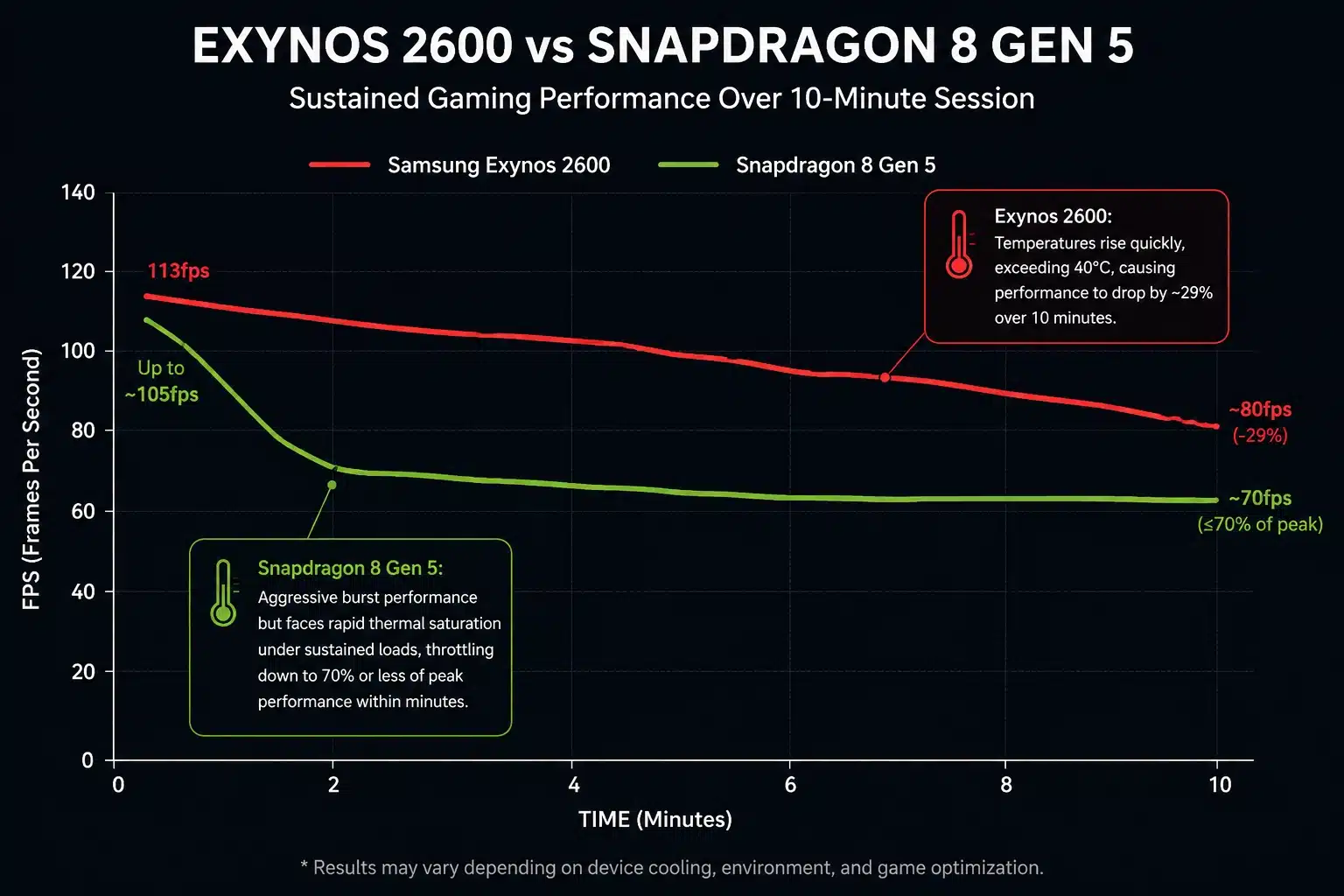
| 5. Gaming & Thermal Throttling | Handles casual and competitive gaming well, but prolonged high-load gaming may introduce earlier thermal throttling on some devices. Overall performance depends heavily on the phone’s cooling solution. | Widely regarded for stable frame rates, better thermal management, and consistent gaming performance during extended sessions. Preferred by many mobile gamers. |
| 6. Camera Optimization | Excellent computational photography with Samsung’s image processing, HDR, AI scene optimization, and advanced video capabilities. Camera quality also depends on Samsung’s software tuning. | Powerful ISP enables fast HDR processing, improved low-light photography, smoother video stabilization, and advanced AI camera enhancements. Often processes images slightly faster in flagship devices. |
| Key Differences | Offers excellent value, seamless integration with Samsung’s ecosystem, and strong everyday performance. Recent generations have significantly narrowed the gap with Snapdragon. | Better suited for users who prioritize peak performance, long gaming sessions, sustained workloads, and maximum power efficiency. Remains the benchmark for flagship Android performance. |
CPU Performance: Which One Feels Faster?
In terms of speed, day-to-day, both the newer Exynos and Snapdragon chips are fast enough to run the usual smartphone tasks without any noticeable slowdowns. The change is minor for most people. If you are checking emails, browsing the web, streaming films, or switching between apps. But Snapdragon tends to have a bit of an edge in raw processing power and sustained performance as workloads get more demanding.
“Performance isn’t bad enough to say don’t buy a phone with these chips, but both underwhelm in their own ways.”
Daily usage
Both processors will provide a seamless and responsive experience for everyday tasks like opening apps, scrolling social media, watching YouTube, or chatting. With faster CPU cores and better memory management in today’s flagship chipsets, apps launch swiftly, animations remain smooth, and multitasking feels seamless. In regular use you’re unlikely to see any real difference until you put two identical Galaxy phones side-by-side.
Heavy Workloads
The lag is especially noticeable when running heavy apps. This puts a lot of pressure on the processor as well, with 4K video editing, processing HD material, exporting large files, and dealing with complex productivity programs all requiring more power.
Snapdragon chips tend to get through these heavy workloads a little faster and also hold higher clock rates for longer. Their better-sustained CPU performance will assist in preventing slowdowns during long editing or rendering sessions as well.
The recent flagship Exynos chips have taken huge leaps from prior generations, delivering a performance closer to Snapdragon than ever before. But under longer, demanding workloads, Snapdragon still has a little lead in peak CPU performance and sustained processing efficiency in general.
Real-World Experience
For the majority of Galaxy customers, both Exynos and Snapdragon deliver a speedy and responsive experience for everyday tasks, multitasking, and entertainment. If you mostly use your phone for browsing, social media, taking photos, streaming, and getting things done.
But if you’re editing movies frequently, completing large-scale projects, or putting your device through intense professional tasks, Snapdragon’s greater sustained CPU performance makes it the better pick for consistently speedier outcomes.
Performance Comparison:
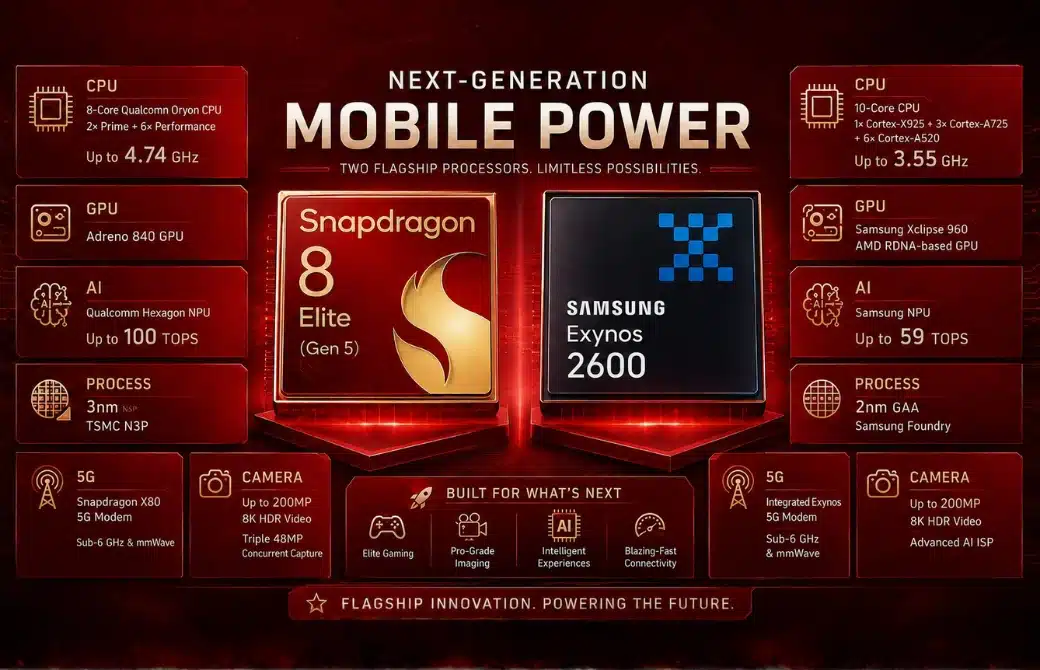
| Feature | Exynos 2600 | Snapdragon 8 Gen 5 (Snapdragon 8 Elite 2) |
| CPU | 10-Core CPU (1× Cortex-X925 + 3× Cortex-A725 + 6× Cortex-A520, up to 3.55 GHz) | 8-Core Qualcomm Oryon CPU (2× Prime + 6× Performance, up to 4.74 GHz) |
| GPU | Samsung Xclipse 960 (AMD RDNA-based) | Adreno 840 GPU |
| AI | Samsung NPU (up to 59 TOPS) | Qualcomm Hexagon NPU (up to 100 TOPS) |
| Process | 2nm GAA (Samsung Foundry) | 3nm (TSMC N3P) |
| 5G | Integrated Exynos 5G Modem (Sub-6 GHz & mmWave) | Snapdragon X80 5G Modem (Sub-6 GHz & mmWave) |
| Cameras | Up to 320MP, 8K HDR Video, Advanced AI ISP | Up to 320MP, 8K HDR Video, Triple 48MP Concurrent Capture |
| Memory Support | LPDDR5X, UFS 4.0 | LPDDR5X, UFS 4.0 |
| Display Support | Up to 4K @ 120Hz / QHD+ 144Hz | Up to 4K @ 120Hz / QHD+ 144Hz |
| Ray Tracing | Hardware-Accelerated Ray Tracing | Hardware-Accelerated Ray Tracing |
| Connectivity | Wi-Fi 7, Bluetooth 5.4 | Wi-Fi 7, Bluetooth 6.0 |
Ultimately, the choice between Samsung Exynos and Snapdragon comes down to how you use your phone. Snapdragon still dominates gaming, sustained performance, and power efficiency, but the latest Exynos chips have caught up with some impressive everyday performance, AI capabilities, and battery optimization. Both offer flagship experiences for most users, so when it comes to the processor, don’t just look at that alone; look at the overall features, software, cameras, and price of the phone to see which phone gives you the best value for your needs.
FAQs: Samsung Exynos vs Snapdragon Processors
1. Which is better, Exynos or Snapdragon?
Snapdragon usually performs better in gaming, sustained performance, and power efficiency. However, modern Exynos processors have improved a lot and now deliver smooth everyday performance, strong AI features, and reliable camera processing.
2. Is Snapdragon better for gaming?
Yes, Snapdragon is generally better for gaming because it offers more stable FPS, stronger GPU performance, and better heat control during long gaming sessions. For heavy gamers, Snapdragon is usually the safer choice.
3. Is Exynos bad for everyday use?
No, Exynos is not bad for daily use. For social media, browsing, YouTube, camera, calls, and multitasking, modern Exynos processors feel fast and responsive. Most casual users may not notice a major difference.
4. Should I avoid Exynos phones?
Not necessarily. If the phone offers good pricing, cameras, battery life, and software support, an Exynos-powered Samsung phone can still be a smart buy. But if you want maximum gaming performance and long-term sustained power, Snapdragon remains the better option.