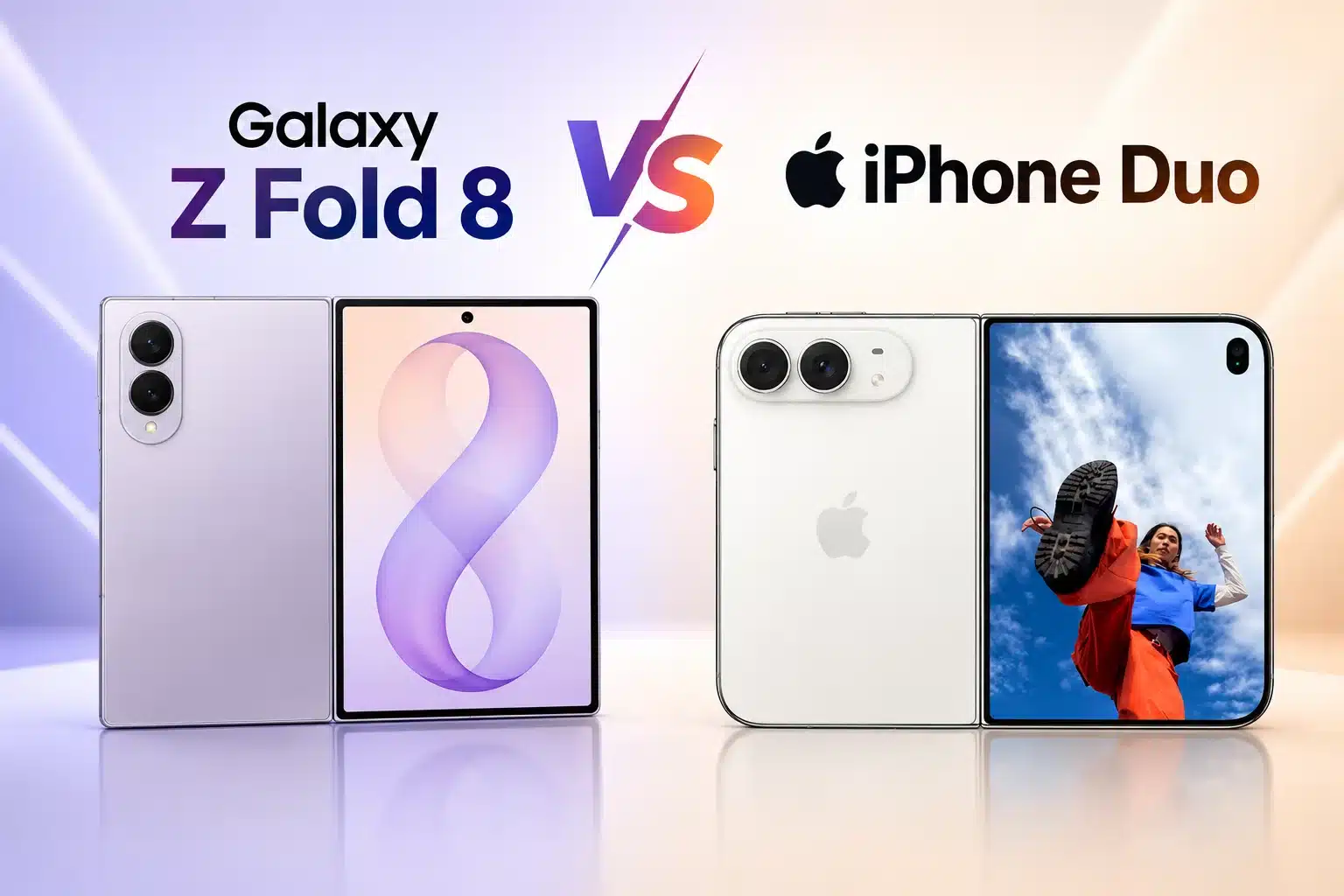
Samsung Galaxy Z Fold 8 vs Apple iPhone Duo

Foldable phones are no longer a niche product. Samsung has led this market for years, and now Apple has joined with its first-ever foldable, the iPhone Duo. Both phones bring big screens, strong chips, and premium build quality. But they take very different paths to get there.
In this article, we compare the Samsung Galaxy Z Fold8 and the Apple iPhone Duo in detail. We look at design, display, camera, battery, software, and price in Bangladesh. By the end, you will know which foldable phone fits your needs and your budget.
Foldable phones solve a simple problem. They give you a small phone for daily use and a large tablet-like screen when you need more space. Samsung has refined this idea over eight generations of the Z Fold series. Apple enters the market late, but it brings fresh ideas like Smart Take and Duo Preview. This comparison will help you decide which approach suits your daily habits better.
Quick Comparison: Fold8 vs iPhone Duo
Before we go deep, here is a quick snapshot of both phones.
| Quick Comparison | ||
|---|---|---|
| Feature | Samsung Galaxy Z Fold8 | Apple iPhone Duo |
| Price in BD | Starts at ৳172,999 | Expected from ৳340,000 |
| Main Display | 7.6″ Foldable AMOLED, 120Hz | 7.6″ Foldable OLED, 120Hz ProMotion |
| Chipset | Snapdragon 8 Elite Gen 5 | Apple A20 Pro (2nm) |
| Main Camera | 50MP + 50MP dual rear | 48MP + 48MP dual rear |
| Battery | 4800mAh, 45W wired | Dual battery, 50% in 20 min |
| OS | Android 17, One UI 9 | iOS 27 |
| Water Resistance | IP48 | IP68 |
Now let’s break down each part in detail.
Design and Build Quality
Both phones use premium materials, but they follow different design goals.
The Samsung Galaxy Z Fold8 weighs just 201 g. It is one of the lightest foldable phones Samsung has made. The body uses Gorilla Glass Victus Ceramic 3 on the folded front, plastic on the unfolded front, and Gorilla Glass Victus 2 on the back. Samsung adds an aluminum frame for extra strength. The phone also carries IP48 water and dust resistance. This rating protects the phone from splashes but not full submersion.
The Apple iPhone Duo takes a heavier approach at 254g. Apple built this phone around a grade 5 titanium frame with a mirror-polished finish. Both the front and back use Ceramic Shield glass. This glass resists scratches and drops better than standard glass. The iPhone Duo also carries an IP68 rating. This means it survives full submersion up to 6 meters for 30 minutes. That makes it far more durable in wet conditions than the Fold8.
Here are the key design differences:
- The Fold8 is lighter and easier to carry in daily use.
- The iPhone Duo uses titanium, which feels more rugged.
- The iPhone Duo has better water resistance (IP68 vs IP48).
- The Fold8 folds slightly slimmer at 9.7mm compared to the Duo’s 11.3mm.
- Both phones use a hinge system built for long-term folding durability.
If you care about weight and slim folding, the Fold8 wins. If you want tougher build quality and better water protection, the iPhone Duo is the safer pick.
Hinge Technology and Long-Term Durability
The hinge is the most important part of any foldable phone. A weak hinge causes screen creases, dust entry, and early wear. Samsung uses its new Flex Titanium structure inside the Fold8. This design spreads pressure evenly across the fold line. It also reduces the visible crease compared to older Z Fold models.
Apple takes a different approach with a titanium hinge and hidden internal supports. The company claims the iPhone Duo can survive years of daily folding without losing its shape. Both brands rate their hinges for hundreds of thousands of folds. In real use, this should cover several years of daily opening and closing.
Buyers should still handle any foldable phone with care. Avoid pressing hard on the center crease, and keep sand or dust away from the hinge area. Both companies offer screen protectors designed for foldable displays, and we recommend using one from day one.
Display Comparison
Display quality matters a lot on a foldable phone. Both companies know this and pushed hard on screen tech.
The Galaxy Z Fold8 uses a 7.6-inch main display with Dynamic LTPO AMOLED 2X technology. It runs at 120Hz and supports HDR10+. Peak brightness reaches 3000 nits, which helps in bright sunlight. The main screen offers 1828 x 2448 resolution. The cover screen measures 5.5 inches with 1248 x 1972 resolution at 428 PPI.
The iPhone Duo also uses a 7.6-inch main display, but with Apple’s Super Retina XDR OLED panel. It supports 120Hz ProMotion, HDR10, and Dolby Vision. Peak brightness also hits 3000 nits. The resolution is slightly higher at 1878 x 2670 pixels, giving about 430 PPI. Apple adds a nano-texture finish and anti-reflective coating, which cuts down glare outdoors. The cover display measures 5.4 inches with a sharp 460 PPI density.
Key display differences:
- Both phones share the same 7.6-inch main screen size.
- The iPhone Duo has a slightly sharper resolution.
- Apple’s nano-texture coating reduces glare better outdoors.
- Samsung’s Vision Booster technology also improves outdoor visibility.
- Dolby Vision support gives the iPhone Duo an edge for movie playback.
Both displays are excellent for daily use, gaming, and streaming. The choice here comes down to ecosystem preference more than raw display quality.
Cover Screen Usability
The cover screen matters just as much as the main display. Most users check notifications, reply to messages, and take quick photos without unfolding their phone. Samsung’s 5.5-inch cover screen runs full apps and supports the same One UI features as the main screen. This makes the Fold8 usable as a normal phone when closed.
Apple’s 5.4-inch cover display also runs full iOS apps, and it uses the same Ceramic Shield protection as the main unit. The higher 460 PPI density makes text look sharper on the smaller screen. Apple also uses the cover display for its Duo Preview camera feature, letting subjects see themselves before a photo is taken. Both cover screens work well for quick tasks, though Samsung’s slightly larger size gives a bit more room for typing and browsing.
Performance and Chipset
Performance defines how smooth a phone feels in daily tasks like multitasking, gaming, and video editing.
The Samsung Galaxy Z Fold8 runs on the Snapdragon 8 Elite Gen 5, built on a 3nm process. It uses an octa-core CPU setup with 2 high-performance cores at 4.74 GHz and 6 mid cores at 3.62 GHz. Graphics come from the Adreno 840 GPU. This chip handles heavy multitasking, split-screen apps, and gaming with ease.
The Apple iPhone Duo uses the new A20 Pro chip, built on an even smaller 2nm process. Apple pairs it with a 7-core Apple GPU. This chip includes a built-in vapor chamber for better cooling during long gaming or editing sessions. The smaller process node usually means better power efficiency.
Performance highlights:
- Both chips rank among the fastest mobile processors available in 2026.
- The A20 Pro’s 2nm process may offer better battery efficiency.
- Snapdragon 8 Elite Gen 5 is proven in many 2026 flagship phones.
- The iPhone Duo’s vapor chamber helps sustain performance during long tasks.
- Both phones support smooth multitasking on their large foldable screens.
For raw benchmark numbers, real-world reviews after launch will confirm which chip performs better. On paper, both processors are top-tier for 2026.
Gaming and Multitasking on a Foldable Screen
A large foldable screen changes how games and apps behave. Samsung’s One UI 9 supports a desktop-style taskbar on the Fold8. Users can run three apps side by side, drag files between windows, and resize app windows freely. This setup works well for people who use their phone as a mini laptop for emails, spreadsheets, and browsing.
Apple’s iOS 27 brings improved Split View and Stage Manager support to the iPhone Duo. Games built for iPad now scale up nicely on the larger inner screen. The A20 Pro’s vapor chamber cooling helps maintain steady frame rates during long gaming sessions. Both phones handle demanding games and heavy multitasking without major slowdown, though Android still offers more flexible window management overall.
Camera Comparison
Camera performance is often the deciding factor for many buyers. Let’s see how these two foldables stack up.
The Galaxy Z Fold8 comes with a dual rear camera setup. It includes a 50MP wide sensor with OIS at f/1.8, and a 50MP ultra-wide sensor at f/1.9. It records video up to 8K at 30 fps. For selfies, it uses a 10MP cover camera and a 10MP main-screen camera, both with HDR support.
The iPhone Duo also uses a dual rear system. It has a 48MP Fusion Main camera with sensor-shift OIS and a 2x optical-quality zoom. The second sensor is a 48MP Fusion Ultra Wide camera. Video recording goes up to 4K at 120fps with Dolby Vision HDR and ProRes support. Apple adds unique folding-camera features:
- Smart Take waits until everyone is ready before it takes the photo.
- Duo Preview shows a live view on the outer screen for better group shots.
Camera comparison summary:
- The Fold8 offers higher-resolution sensors (50MP vs 48MP).
- The Fold8 supports 8K video, while the Duo tops out at 4K.
- The iPhone Duo has smarter folding-specific camera features like Smart Take.
- Apple’s ProRes and Dolby Vision HDR video appeal more to content creators.
- Samsung’s camera system benefits from years of foldable camera tuning.
Photography needs vary by user. If you shoot a lot of video content, the iPhone Duo’s ProRes support is a strong advantage. If you want higher-resolution stills and simpler photo modes, the Fold8 delivers reliable results.
Selfie and Group Photo Experience
Foldable phones change how people take selfies and group photos. The main camera also works as a selfie camera when the phone is open. This gives users much higher-quality self-portraits than a typical front camera allows.
On the Galaxy Z Fold8, users can point the rear 50MP camera at themselves while using the cover screen as a viewfinder. This trick, often called a flex-mode selfie, produces sharper results than the dedicated 10MP selfie sensors. The iPhone Duo pushes this idea further with Duo Preview. It shows a live camera feed on the outer screen, so the subject can check their pose first. Combined with Smart Take, which waits until everyone is ready, group photos become much easier to get right.
Battery and Charging
Battery life on a foldable phone needs to support two screens at once. Both brands solve this differently.
The Galaxy Z Fold8 packs a 4800mAh dual battery. It supports 45W wired charging, reaching 63% in 30 minutes. Wireless charging tops out at 20W, and reverse wireless charging runs at 4.5W. This setup gives solid all-day battery life for most users.
The iPhone Duo also uses a dual-battery system, with one battery on each side of the phone. Apple claims up to 44 hours of video playback on the outer screen and 31 hours on the inner screen. Wired charging reaches 50% in just 20 minutes. Wireless charging through MagSafe or Qi2 runs at 25W.
Battery comparison points:
- The iPhone Duo charges to 50% faster than the Fold8 (20 min vs 30 min for a lower percentage).
- Samsung’s 4800mAh capacity is a known, proven number.
- Apple’s claimed video playback hours suggest strong battery efficiency.
- Both phones support fast wireless charging above 20W.
- Real-world battery life will depend on screen brightness and daily usage patterns.
Both phones should comfortably last a full working day. Heavy users who game or record video often will want to test actual battery life after launch.
Charging Habits for Foldable Phone Owners
Foldable phones drain battery faster than normal phones because they power two screens. Daily charging habits matter more here than on a regular flagship. We recommend charging both phones overnight and topping up during short breaks using fast wired charging.
The Fold8’s 45W charger takes it from empty to 63% in half an hour. That is usually enough for a full day if you top up during lunch. The iPhone Duo charges even faster to 50% in 20 minutes, which suits users who forget to charge overnight. Wireless charging is best used as a convenience option rather than the main charging method, since wired charging remains faster on both devices. Neither phone includes a charger in the box, so buyers should plan to use an existing USB-C charger or buy one separately.
Software and Operating System
Software experience is where these two phones split completely.
The Galaxy Z Fold8 runs Android 17 with One UI 9 on top. Samsung promises up to 7 major Android upgrades, which is one of the longest support periods in the industry. One UI is built for foldables, with features like multi-window apps, drag-and-drop, and a taskbar similar to desktop computers.
The iPhone Duo runs iOS 27, Apple’s first foldable-optimized software. Apple also added new child safety tools in this release, giving parents better control over screen time and content. Since the phone folds, Apple moved away from Face ID. Instead, Touch ID sits inside the side button. Users can also unlock the phone using a nearby Apple Watch.
Software differences:
- Android 17 offers more customization and multitasking flexibility.
- iOS 27 offers a cleaner, more locked-down experience with strong privacy tools.
- Samsung supports 7 years of major OS upgrades.
- Apple’s move to Touch ID changes how Face ID users will unlock their phone.
- App ecosystem choice (Android vs iOS) will likely decide this category for most buyers.
If you are already inside the Apple ecosystem with a Mac, iPad, or Apple Watch, the iPhone Duo fits naturally. If you prefer open customization, Android and One UI 9 give more control.
App Support for Foldable Displays
Software features only matter if apps actually use the extra screen space. Samsung has spent years working with developers to optimize popular apps for the Fold series. Apps like Google Docs, YouTube, and Instagram already support split layouts on One UI.
Apple is newer to this space, but its strict App Store guidelines usually push developers to update apps quickly. Expect major apps like Gmail, Netflix, and social media platforms to receive foldable-optimized layouts soon after the iPhone Duo launches. Until then, some apps may simply stretch to fill the screen without extra features. Both platforms will keep improving foldable app support through regular software updates over the next year.
Price in Bangladesh
Price is often the biggest factor for buyers in Bangladesh. Here is how these two foldables compare.
The Samsung Galaxy Z Fold8 price in Bangladesh starts at ৳172,999 and goes up to ৳229,999, depending on storage and RAM. Mobile Buzz BD offers both official and unofficial variants.
The Apple iPhone Duo has not launched officially in Bangladesh yet. Based on expected import costs and the current dollar rate, the price is expected to start around ৳340,000 for the base 256GB model. Higher storage options may cost significantly more.
| Apple iPhone Duo Expected Price in Bangladesh | |
|---|---|
| Storage | Expected Price |
| 256GB | ৳340,000 – ৳380,000 |
| 512GB | ৳390,000 – ৳430,000 |
| 1TB | ৳460,000 – ৳500,000 |
| 2TB | ৳540,000 – ৳580,000 |
The price gap between the two phones is huge. The iPhone Duo costs almost double the base Fold8 price. This difference alone will push many budget-conscious buyers toward Samsung’s foldable.
Mobile Buzz BD also offers a special pre-order deal for the iPhone Duo. Customers can pre-book the phone for just ৳10,000. The first 18 pre-order customers get free Apple AirPods. Every pre-order also comes with a 10-day replacement guarantee.
EMI and Payment Options
Both phones are available with EMI plans through Mobile Buzz BD. This helps buyers spread out the cost over several months instead of paying the full amount at once. EMI availability depends on your bank and card type, so it is best to confirm current offers before ordering.
For a phone priced above ৳300,000 like the iPhone Duo, EMI plans make the purchase much more manageable for salaried buyers. The Fold8’s lower starting price already puts it within reach for more customers without financing. Anyone planning to buy either phone should call Mobile Buzz BD support to check the latest EMI bank list and interest-free installment options.
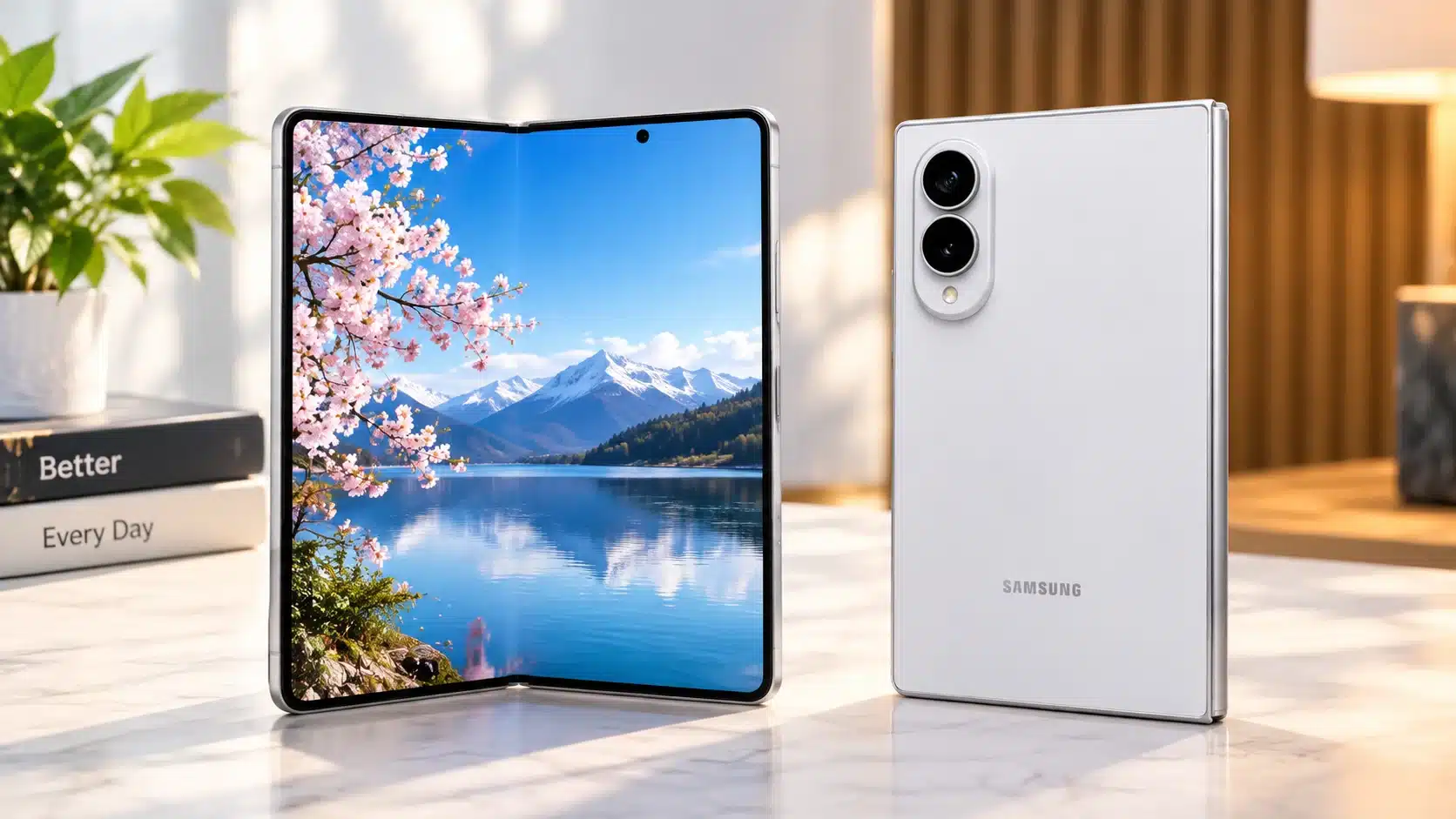
Full Specification Comparison
Here is a detailed side-by-side comparison table of both foldable phones.
| Network | ||
|---|---|---|
| Technology | GSM / HSPA / LTE / 5G | GSM / HSPA / LTE / 5G |
| Launch | ||
| Announced | 22 July, 2026 | 09 September, 2026 |
| Status | Available | Coming soon, exp. 23 October 2026 |
| Body | ||
| Weight | 201g | 254g |
| Build | Gorilla Glass Victus Ceramic 3, aluminum frame | Ceramic Shield glass, titanium frame |
| Water Resistance | IP48 | IP68 |
| SIM | Nano-SIM + eSIM + eSIM | eSIM only (dual) |
| Display | ||
| Main Size | 7.6-inch AMOLED | 7.6-inch Super Retina XDR OLED |
| Cover Size | 5.5-inch | 5.4-inch |
| Refresh Rate | 120Hz | 120Hz ProMotion |
| Peak Brightness | 3000 nits | 3000 nits (peak) |
| HDR Support | HDR10+ | HDR10, Dolby Vision |
| Platform | ||
| OS | Android 17, One UI 9 | iOS 27 |
| Chipset | Snapdragon 8 Elite Gen 5 (3nm) | Apple A20 Pro (2nm) |
| GPU | Adreno 840 | Apple GPU (7-core) |
| Memory | ||
| Storage Options | 256GB, 512GB, 1TB, 1TB (16GB RAM) | 256GB, 512GB, 1TB, 2TB (12GB RAM) |
| Card Slot | No | No |
| Main Camera | ||
| Rear Setup | 50MP wide (OIS) + 50MP ultra-wide | 48MP wide (OIS) + 48MP ultra-wide |
| Video | 8K@30fps, 4K@30/60/120fps | 4K@up to 120fps, ProRes, Dolby Vision HDR |
| Selfie Camera | ||
| Cover Camera | 10MP, HDR | 12MP, f/2.2, AF |
| Main Screen Camera | 10MP | Under-display camera |
| Battery | ||
| Capacity | 4800mAh (dual battery) | Dual battery (capacity not disclosed) |
| Wired Charging | 45W, 63% in 30 min | 50% in 20 min |
| Wireless Charging | 20W | 25W (MagSafe/Qi2) |
| Price in Bangladesh | ||
| Starting Price | ৳172,999 | Expected ৳340,000 |
Who Should Buy the Samsung Galaxy Z Fold8?
The Fold8 makes sense for buyers who want a proven foldable at a lower price point. Consider this phone if:
- You want a lighter foldable phone for everyday carrying.
- You need higher resolution cameras with 8K video recording.
- You prefer Android’s flexibility and multi-window productivity tools.
- Your budget sits under ৳230,000 for a premium foldable.
- You want long-term software support with up to 7 OS upgrades.
Who Should Buy the Apple iPhone Duo?
The iPhone Duo suits buyers who are already inside the Apple ecosystem and want the best build quality. Consider this phone if:
- You already own an iPhone, Mac, iPad, or Apple Watch.
- You want the toughest build with a titanium frame and an IP68 rating.
- You record a lot of video and want ProRes and Dolby Vision support.
- Budget is not your main concern, and you want Apple’s first foldable.
- You want stronger child safety controls for family use.
Accessories and Ecosystem Fit
Buying a foldable phone often means buying into a wider ecosystem of accessories and connected devices. This choice affects your experience long after the purchase.
The Galaxy Z Fold8 works smoothly with Samsung Galaxy Watches, Galaxy Buds, and Samsung tablets. Features like Quick Share and Samsung DeX let users move files and mirror their screen to a monitor easily. Samsung also sells folding-friendly cases and S Pen accessories that support note-taking directly on the large display.
The iPhone Duo connects naturally with AirPods, Apple Watch, and MacBooks through Apple’s Continuity features. Users can start a task on their Mac and finish it on the iPhone Duo without extra setup. Apple Pencil support, arriving later in 2026, will add note-taking and sketching to the mix as well. If your other devices are already Samsung or Apple products, that ecosystem will likely shape your final choice more than any single spec.
Frequently Asked Questions
Which foldable phone has a bigger main display?
Both phones use a 7.6-inch main display. The iPhone Duo has a slightly sharper resolution at 430 PPI.
Is the Samsung Galaxy Z Fold8 cheaper than the iPhone Duo?
Yes. The Fold8 starts at ৳172,999, while the iPhone Duo is expected to start near ৳340,000 in Bangladesh.
Which phone has better water resistance?
The iPhone Duo has an IP68 rating and survives full submersion. The Fold8 carries an IP48 rating, built mainly for splash protection.
Can I pre-order the iPhone Duo from Mobile Buzz BD?
Yes. Mobile Buzz BD accepts pre-orders for ৳10,000. The first 18 customers also receive free Apple AirPods.
Which phone has a better camera for video recording?
The iPhone Duo supports ProRes and Dolby Vision HDR video, which appeals to content creators. The Fold8 supports 8K recording, which gives higher resolution footage.
Does the Galaxy Z Fold8 support expandable storage?
No. Neither the Fold8 nor the iPhone Duo has a memory card slot.
Will the iPhone Duo work with a physical SIM card?
No. The iPhone Duo uses eSIM only, with support for two active eSIMs at once.
Which phone has a longer software update commitment?
The Samsung Galaxy Z Fold8 offers up to 7 major Android upgrades. This is longer than most flagship phones on the market.
Does Mobile Buzz BD offer a warranty on both phones?
Yes. Official variants get a 1-year brand warranty, and unofficial variants come with a 10-day replacement guarantee, plus 1-year free service from Mobile Buzz BD.
Can I use Apple Pencil with the iPhone Duo?
Yes. The Apple Pencil with USB-C works with the iPhone Duo, though this support arrives later in 2026.
Final Verdict
Both foldable phones bring strong technology to the table, but they serve different buyers. The Samsung Galaxy Z Fold8 offers excellent value, a lighter body, and a mature Android experience at almost half the price. The Apple iPhone Duo brings Apple’s first foldable design, a tougher titanium build, and deeper iOS integration, but at a much higher cost.
If price and camera resolution matter most, go with the Fold8. If you want Apple’s ecosystem and the toughest build quality, the iPhone Duo is worth the extra cost.
Visit Mobile Buzz BD showrooms at Jamuna Future Park or Bashundhara City to see both phones in person. You can also call 09613-668844 for the latest price and stock updates.