
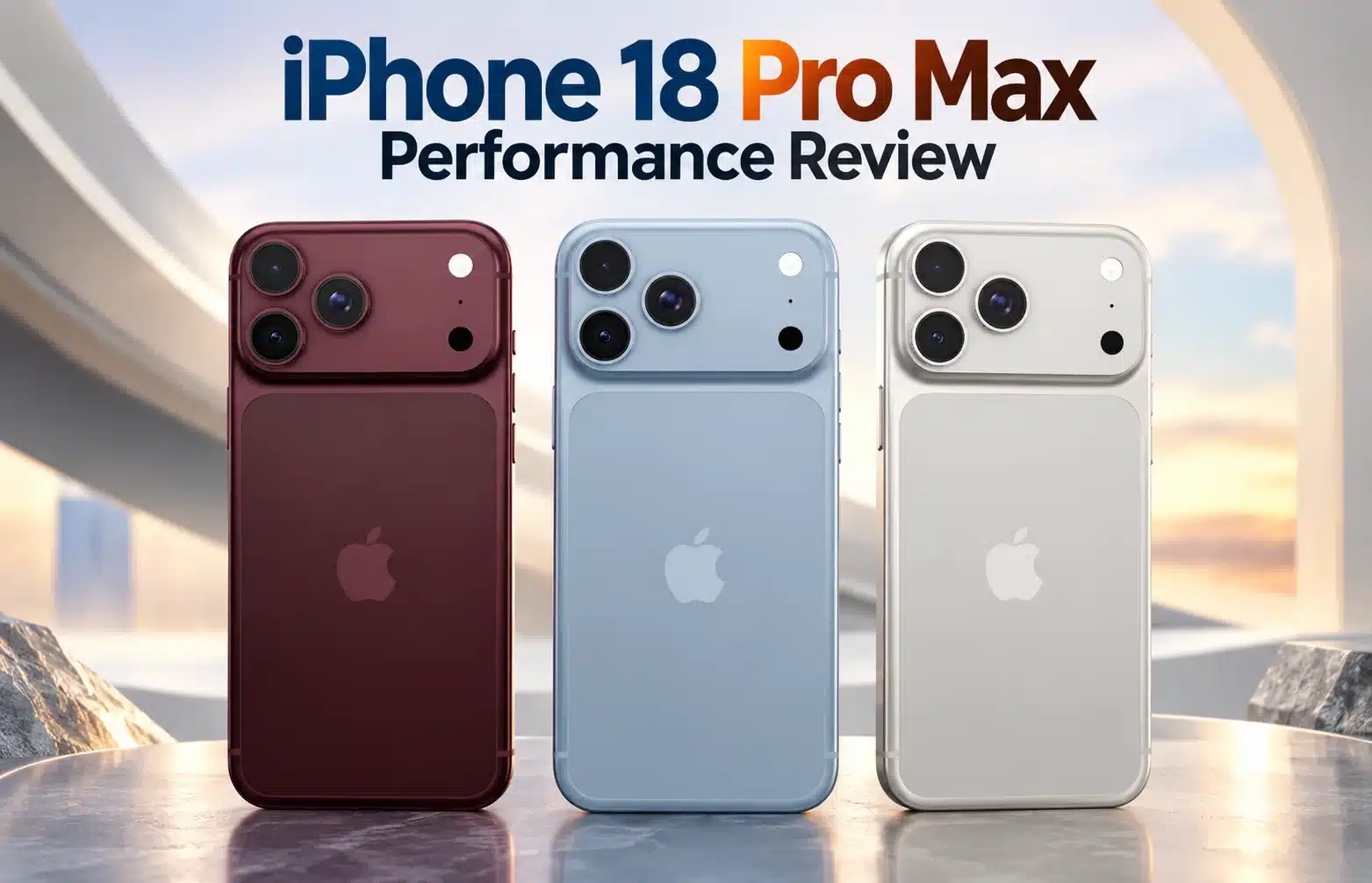
iPhone 18 Pro Max Performance Review

Is the new A20 Pro chip a meaningful leap over the A19 Pro? The answer goes beyond benchmark scores. Built on a 2nm process, the iPhone 18 Pro Max pairs 12GB RAM & a large vapor chamber. This combination allows for faster processing and better heat control.
But raw power is only half the story. The real test is whether it can maintain that speed during,
- Long gaming sessions
- Demanding 4K video recording, and
- Everyday multitasking
Surprisingly, a faster chip means little if heat slows it down. So, does the Apple iPhone 18 Pro Max deliver a genuine upgrade in performance and efficiency? Read our review to explore our performance test and how it compares with its predecessor.
iPhone 18 Pro Max Performance at a Glance
The iPhone 18 Pro Max combines Apple’s brand-new, powerful 2nm A20 Pro chip with an upgraded cooling system. Here are its key performance specifications.
| Component | Specifications |
| Chipset | Apple A20 Pro |
| Manufacturing Process | 2nm process by TSMC |
| CPU | Total 6-core CPU: 2 super cores + 4 efficiency cores |
| CPU Clock Speed | Up to 4.93GHz super cores; 2.64GHz efficiency cores |
| GPU | 7-core Apple GPU |
| Graphics Features | Hardware-accelerated ray tracing and Neural Accelerators |
| NPU / Neural Engine | Dual 16-core Neural Engine, 32 cores total |
| RAM | 12GB |
| Memory Bandwidth | 50% higher than A19 Pro |
| Memory Packaging | Side-by-side processor and memory layout |
| Cooling System | Vapor chamber with 3× the surface area of the previous generation |
What Makes the iPhone 18 Pro Max Faster?
A faster phone is not just about a powerful chip. It also needs to manage heat, move data quickly, and use less power during demanding tasks. Here are some of the specs that make the iPhone 18 Pro Max much stronger:
2nm Manufacturing Process
The A20 Pro uses TSMC’s 2nm manufacturing process. This is a major step forward from the previous generation. A smaller process can fit more transistors into a given area and improve performance per watt. In everyday use, this can mean
- Faster app launches
- Smoother multitasking, and
- Lower power consumption
Particularly, improved efficiency matters during long gaming sessions and 4K video recording. These activities put continuous pressure on the processor and battery.
CPU, GPU & NPU Layout
The A20 Pro CPU, GPU, and NPU features RAM and a redesigned side-by-side memory layout. Instead of stacking RAM directly above the processor die, this layout places the memory alongside it. This arrangement increases unified memory bandwidth by 50% and improves heat dissipation. As a result,
- The CPU can handle demanding tasks
- The GPU can process graphics smoothly, and
- The NPU can speed up supported AI workloads
Together, these components aim to deliver faster multitasking and more efficient performance under heavy workloads.
CPU Architecture
The six-core CPU with two super cores clocked at up to 4.93GHz and four efficiency cores running at up to 2.64GHz. The super cores handle demanding tasks, such as video rendering. Meanwhile, the efficiency cores manage lighter workloads with less power. This balance allows the iPhone to respond quickly without using the greatest power for every task. Apple claims up to 20% faster CPU performance over the A19 Pro.
GPU Performance and Hardware Ray Tracing
Graphics performance benefits from the A20 Pro’s seven-core GPU. It supports hardware-accelerated ray tracing. This system can produce more realistic reflections, lighting, and shadows in compatible games. The GPU also delivers up to 40% better performance than its predecessor. Notably, the chip’s integrated neural accelerators can also assist supported AI-related workloads.
NPU and Neural Engine
The A20 Pro uses a dual 16-core Neural Engine architecture. This system also boasts 32 cores in total, alongside integrated neural accelerators. This setup is claimed to deliver twice the AI and machine-learning processing power of its predecessor. The practical benefits could include faster supported AI tasks, computational photography, image processing, and other machine-learning features. It also improves the speed of certain on-device Apple Intelligence functions.
RAM and Memory Bandwidth
The iPhone 18 Pro Max comes with 12GB of RAM and a redesigned side-by-side memory-to-processor layout. More RAM gives demanding apps extra working space. Higher memory bandwidth allows the processor and GPU to access data more quickly. Together, these improvements can benefit multitasking, high-resolution video editing, graphics-heavy games, and AI workloads.
Larger Vapor Chamber
Raw processing power means little if heat forces the chip to slow down. This new Apple flagship features a deionized water vapor chamber that is three times the size of the previous generation’s. It spreads heat away from the processor to reduce concentrated hot spots. This matters during extended 3D gaming, long 4K video recordings, and other sustained workloads. Also, this upgraded cooling system helps the phone maintain more consistent performance. It can also reduce heat-related stress on the battery.
iPhone 18 Pro Max Performance Review: Our Testing Results
The iPhone 18 Pro Max scores up to 48.5% higher in AnTuTu 11 than the iPhone 17 Pro Max. But raw scores tell only part of the story.
1. CPU Throttling Test
Our stress-test results show that the iPhone 18 Pro Max retained 83.87% of its peak CPU performance, compared with 87.93% for the iPhone 17 Pro Max. Surprisingly, the newer model recorded a lower performance-retention percentage. However, this does not automatically mean the older phone performs better. The A20 Pro starts from a higher reported performance level. So post-throttling scores are needed to compare their actual speeds.
2. New Vapor Cooling Chamber
The iPhone 18 Pro Max features a vapor chamber three times larger than the previous generation’s cooling system. It spreads heat away from the processor during demanding tasks. This can reduce hot spots and maintain more stable performance during extended gaming and 4K video recording. Better temperature control may also reduce thermal stress on the lithium-ion battery over time.
3. Gaming Performance
The 3DMark Wild Life Extreme results show a score of 7,931, compared with 6,031 for the iPhone 17 Pro Max. That’s an improvement of approximately 31.5%. This suggests a substantial gain in graphics performance under the tested conditions. The A20 Pro’s GPU and hardware-accelerated ray tracing could also improve graphics quality in supported games.
4. Battery Life and Power Efficiency
The 2nm A20 Pro chip aims to deliver more processing power while using less energy. Combined with the larger vapor chamber, this could improve battery efficiency during demanding tasks. Your results suggest the phone can last around 30 hours on a single charge. This is even after a couple of hours of demanding gameplay.
5. Apple Intelligence and Siri AI
The A20 Pro reportedly doubles the Neural Engine’s AI processing power compared with the previous generation. This could speed up supported on-device AI tasks, computational photography, and image processing. Siri may also benefit from faster local processing for compatible features. For everyday users, the practical advantage could be quicker responses and smoother AI-assisted workflows.
iPhone 18 Pro Max vs. iPhone 17 Pro Max: Performance Comparison
| Benchmark | iPhone 18 Pro Max | iPhone 17 Pro Max | Improvement |
| Geekbench 6 Single-Core | 4,735 | 3,891 | 21.7% |
| Geekbench 6 Multi-Core | 12,794 | 10,118 | 26.4% |
| AnTuTu 11 | 3,463,072 | 2,331,417 | 48.5% |
| 3DMark Wild Life Extreme | 7,931 | 6,031 | 31.5% |
iPhone 18 Pro Max vs Samsung Galaxy S26 Ultra: Performance Comparison
On paper, the iPhone 18 Pro Max vs Galaxy S26 Ultra difference may look equally powerful. But in everyday use, the Galaxy S26 Ultra offers slightly more performance than the 18 Pro Max. However, that doesn’t mean the S26 Ultra provides the best performance all the time.
| Feature | iPhone 18 Pro Max | Galaxy S26 Ultra |
| Display | 6.9″ LTPO Super Retina XDR OLED | 6.9″ Dynamic LTPO AMOLED 2X |
| Refresh Rate | 120Hz | 120Hz |
| Resolution | 1320 × 2868 | 1440 × 3120 |
| Chipset | Apple A20 Pro, 2nm | Snapdragon 8 Elite Gen 5, 3nm |
| RAM | 12GB | 16GB |
| OS | iOS 27 | Android 16 / One UI 8.5 |
| Main Camera | 48MP triple camera | 200MP quad camera |
| Battery | Up to 5567 mAh (e-Sim) | 5000 mAh |
| Storage | Up to 2TB | Up to 1TB |
| Biometric Security | Face ID | Ultrasonic fingerprint |
| Water Resistance | IP68 dust tight and water resistant | IP68 dust tight and water resistant |
Final Verdict: Is the iPhone 18 Pro Max the Performance Upgrade to Buy?
Based on the shared benchmark results, the iPhone 18 Pro Max shows a significant performance boost over the iPhone 17 Pro Max. Its A20 Pro chip surprisingly delivers up to 48.5% higher AnTuTu scores and 31.5% better 3DMark performance. Also, the 2nm process, 12GB of RAM, and a larger vapor chamber could benefit gaming, multitasking, and AI tasks.
So, real-world gaming, temperature, and battery tests confirm its efficiency. It looks promising for power users and gamers, but everyday users may notice fewer benefits. So, one thing is recommended: check our independent test results before upgrading.


