Apple iPhone Duo Review: The Foldable iPhone That Changes the Rules

What if your iPhone suddenly became like a mini iPad without leaving your pocket? That is the idea behind Apple’s iPhone Duo! A foldable iPhone from Apple that opens up into a huge 7.6-inch display. Surprisingly, Apple has not simply made a larger screen. It has reworked the hinge, display layers, software, and even the way you interact with iOS. The results feel familiar when folded, yet remarkably different when opened.
Moreover, the inner display has a crease as thin as 0.15mm. Meanwhile, the reimagined iOS 27 brings multitasking features that make better use of the extra space. But this revolutionary form factor also comes with compromises. There is no Face ID, no physical SIM slot, and the under-display selfie camera may disappoint some users. So, is the iPhone Duo the foldable iPhone we have been waiting for, or does Apple still have problems to solve? Let’s break it down!
Apple iPhone Duo: Specs at a Glance
| Display |
|
| Refresh Rate | 120Hz ProMotion |
| Brightness | Up to 3,000 nits peak (for both inner and outer) |
| Display Protection | Nano-texture finish, anti-reflective coating, scratch-resistant inner display |
| Crease | As low as 0.15mm |
| Chipset | Apple A20 Pro (2nm) |
| RAM & Storage | 12GB RAM with 256GB, 512GB, 1TB, up to 2TB storage options |
| Rear Camera | 48MP Main + 48MP Ultrawide Dual Fusion Camera |
| Front Camera | 12MP Center Stage + Under-display FaceTime camera |
| Biometrics | Side-mounted Touch ID |
| Battery & Charging | Around 5,400mAh, dual-battery system, up to 50% in around 20 minutes
25W MagSafe/Qi2 wireless |
| Software | iOS 27 |
| Connectivity | 5G, Wi-Fi, Bluetooth, NFC, UWB |
| SIM | eSIM-only |
| Build | Grade 5 titanium frame and hinge cover, Ceramic Shield |
| Durability | IP68 water and dust resistance |
Apple iPhone Duo – In-Depth Review
A foldable phone can look impressive on a specification sheet. But the real test starts when you pick it up and open it. The Apple iPhone Duo takes a different approach. Instead of complicating the folding experience, Apple makes the transition feel natural.
The Moment You Open It, You Understand the Point
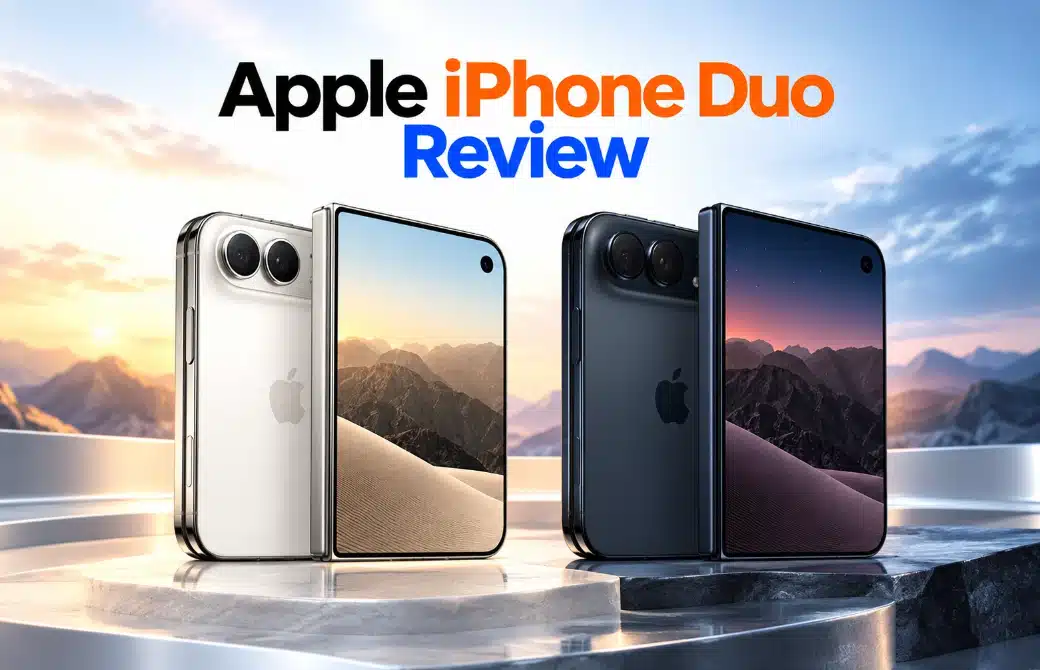
When you look at the iPhone Duo, you do not notice its specifications at first glance. It is a change in scale. The compact 5.4-inch outer display feels easy to handle. Its D-shaped design also gives the phone a distinctive look. It feels more like a narrow and traditional phone than a typical wide foldable when closed.
Then you open it, and the experience changes completely.
The 7.6-inch inner display gives you 50% more screen space than the iPhone 18 Pro Max. That extra room is not just useful for watching videos. It changes how you interact with the phone.
- Websites show more content at once
- Long articles feel easier to read
- Photos have more room to breathe
- You can also keep a video at the top while using another app below it
Aside from that, the wide keyboard gives your fingers more room. This makes it easier to type longer messages and emails. Browsing and scrolling also feel closer to a small tablet. In fact, once unfolded, the iPhone Duo feels more like an iPad than a conventional iPhone.
But there is a trade-off: The Duo is not slim when folded!
The hinges & dual-screen hardware add noticeable thickness. You will also feel that extra bulk in your hand, especially during longer one-handed sessions.
Two Screens, Two Personalities
A foldable phone usually offers two screens. But the iPhone Duo makes each one feel useful for a different purpose. The outer display is for convenience, while the inner screen is where the Duo truly comes alive.
When Folded:
The 5.4-inch outer display keeps the iPhone Duo compact enough for everyday tasks. You can reply to messages, answer calls, check notifications, search the web, or scroll through social media without opening the phone. Its smaller size also makes one-handed use easier, particularly when walking or using the phone on the go.
When Unfolded:
Open the Duo, and the experience changes dramatically. The 7.6-inch LTPO Super Retina XDR OLED becomes your main workspace. It supports a 120Hz refresh rate, HDR10, and Dolby Vision, so scrolling feels smooth while movies and supported videos look richer and more detailed.
The 3,000-nit peak brightness also ensures strong visibility of the inner screen outdoors. More importantly, the larger canvas makes everyday tasks more comfortable.
- Reading long articles feels like reading a tablet.
- Games get more controls and visuals.
- Movies have become far more immersive.
You can also use the extra space to boost productivity and multitask. This is where the iPhone Duo delivers its mini-iPad experience. You get the convenience of an iPhone when folded, then a much larger workspace when opened.
Apple’s Most Interesting Foldable Problem Isn’t the Fold
A 0.15mm crease may seem like a tiny amount. But on a foldable phone, it can make a huge difference. Apple clearly knew that the display crease would be one of the first things users noticed. So, rather than treating it as an unavoidable part of the foldable experience, the iPhone Duo takes several steps to make it less noticeable.
The inner display uses more than 10 ultra-thin layers that work together as the screen folds and unfolds. A layered glass construction allows the internal layers to move relative to one another, like the pages of a book.
Apple also adds a custom nano-texture polymer finish to the inner screen. It scatters light rather than highlighting the crease. An anti-reflective coating adds another layer of protection against distracting reflections.
Note: Apple has also taken a novel approach to long-term maintenance. The Nano-Texture cover layer can be replaced at an Apple Service Center if it is damaged or if you want to restore the display’s smooth appearance.
Behind the Hinge: 100+ Parts Holding the Duo Together
More than 100 precision components work inside the iPhone Duo’s hinge. That number tells you how seriously Apple takes folding durability. At the center is a custom hinge made from Grade 5 titanium. This provides the strength needed to withstand repeated openings and closings.
A titanium backing plate adds further support around the fold area. Meanwhile, optical adhesives keep the display layers securely connected without adding bulk to the hinges. The hinge also uses a variable torque profile, so the resistance changes as you open or close the phone. Despite all this hardware, the hinge feels thin but substantial in the hand.
A20 Pro: More Than Just a Faster Chip
When a powerful chip, two displays, and heavy multitasking work together, thermal control becomes just as critical as raw speed. This is where the Apple A20 Pro becomes more interesting. Built on a 2nm process, it brings a 20% faster 6-core CPU and 50% more memory bandwidth.
Notably, the A20 Pro uses a dual 16-core neural engine for AI and on-device processing. This means more tasks can happen directly on the iPhone without relying on the cloud. Features such as smart image processing, focus tracking, and other AI-powered functions can benefit from this extra processing power.
But sustained performance matters more than a quick benchmark score. The iPhone Duo uses advanced thermal management with a vapor chamber to move heat away from the processor. This is particularly helpful during long gaming sessions.
Reimagined iOS 27: Where Hardware Finally Makes Sense
A bigger screen is only useful if software knows what to do with it. This is where iOS 27 becomes one of the most significant parts of the iPhone Duo. Apple has reworked the experience around the foldable form factor, so the 7.6-inch display feels more like a workspace than a stretched phone screen.
The biggest change is Split View. You can open Photos and Mail side by side instead of switching between them. Found a picture you want to send? Drag it from Photos and drop it into Mail. This simple interaction makes the Duo feel closer to an iPad.
The fold-and-unfold transition is another small detail that makes a big difference. When you open the Duo, iOS 27 smoothly moves the experience from the outer display to the larger inner screen. Fold it back, and the content transitions naturally to the outer display.
StandBy also becomes more useful on the Duo. It does not need a charger. You can simply place the phone at an angle and use the larger screen for the clock, photos, weather, calendar, or widgets. This also makes hands-free FaceTime more practical. The phone can stand on its own while you talk, so you don’t have to hold it.
The Battery Has a Clever Trick Inside
A foldable needs more battery than a regular phone. But it also has less internal space to work with. The iPhone Duo tackles this challenge with a clever dual-battery architecture. It packs around 5,400mAh of total capacity across two battery cells. This gives the large 7.6-inch display enough power without making the phone bulkier.
The internal space-saving eSIM design also gives Apple more room for the battery system. There is no physical SIM slot inside the frame. When paired with the efficient C2 modem, the Duo can manage power more efficiently in everyday use.
Charging is another strong point. The iPhone Duo can reach 50% charge in 20 minutes with fast wired charging. This is particularly useful when you are in a hurry. Short charging sessions can give you enough power to use for several hours. For wireless charging, it supports up to 25W through MagSafe and Qi2.
The iPhone Duo has got many key things right. It has
- A powerful chip
- A clever battery system
- Convenient inner display and
- Software that finally understands the foldable form factor
But no folding is flawless. Apple has also made some choices that matter daily.
The iPhone Duo’s Biggest Compromises
The iPhone Duo solves several foldable problems, but it also creates a few new ones. Some missing features may look small on paper. In daily use, however, they can matter.
- No Face ID: The biggest change is the missing Face ID. Instead, the iPhone Duo uses Touch ID built into the side-mounted power button. It still gives you secure biometric access, but it does not offer the same hands-free convenience as Face ID. Notably, Samsung’s Galaxy Z Fold series, like Galaxy Z Fold8 Ultra and Z Fold8, still offers face recognition alongside other biometric options.
- No Physical SIM Slot: The iPhone Duo is eSIM-only. There is no physical nano-SIM slot. This keeps the internal design simpler and saves some space. But it can be inconvenient for users who regularly move physical SIM cards between foldable phones.
- No Action Button: Apple has also left out the Action Button. This may disappoint users who are already used to quickly switching between silent mode, focus, camera, flashlight, or other shortcuts.
- The Under-Display Selfie Camera Compromise: The under-display FaceTime camera keeps the inner screen clean. There is no visible camera cutout interrupting the large 7.6-inch display. That looks great, particularly when watching movies or using the Duo like a mini tablet. But there is a trade-off. The camera sits behind the display, so image quality can suffer compared with a traditional selfie camera. Fine details, sharpness, and overall image quality may not match what you expect from a premium iPhone.
- Higher Price: Then comes the biggest compromise: the price. The iPhone Duo costs $100 more than the Samsung Galaxy Z Fold 8. That puts it firmly in the premium foldable category.
Overall, these compromises do not ruin the iPhone Duo. But they show that Apple’s first foldable is not a perfect package. The bigger question is whether its display, software, performance, and ecosystem advantages are strong enough to justify these trade-offs.
iPhone Duo vs. Other Foldable Giants
The foldable market now has three major approaches: Apple, Samsung, and Xiaomi. The iPhone Duo brings Apple’s ecosystem and iOS 27 to the category. Meanwhile, the Samsung Galaxy Z Fold 8 focuses on a mature foldable experience with strong multitasking and flexible hardware. The Xiaomi 18 Fold takes a more aggressive approach with flagship hardware and a large-screen experience.
Apple’s biggest advantage is how tightly the hardware and software work together. iOS 27 makes the Duo feel more like an iPhone when folded and an iPad when opened. Samsung has the advantage of a more established foldable lineup. However, Xiaomi appeals to users seeking robust hardware and a distinct Android experience.
Apple Finally Made a Foldable iPhone: But Is It Actually Better?
The iPhone Duo is not simply an iPhone that folds. That’s what’s crucial to understand. Apple is trying to combine the convenience of an iPhone with the workspace of a mini iPad. That difference creates the Duo’s biggest first impression. You start with a small phone in your hand. Then, with one movement, you get a much larger screen for watching videos, browsing, gaming, reading, and multitasking.
The wider workspace also makes Split View, drag-and-drop, and hands-free use feel more natural. But Apple solves more than the screen-size problem. The company is also trying to make a foldable device reliable for long-term use. However, there are still compromises. There is no Face ID, no physical SIM slot, and no Action Button.
So, is the iPhone Duo actually better than other foldables? It may be different in every way. Samsung and Xiaomi still have strong alternatives. But the Duo feels different because Apple won’t be making a foldable phone.
It tries to answer the following question: What if an iPhone could become an iPad whenever you needed more space? Surprisingly, that simple combination may be what makes Apple’s first foldable feel genuinely useful rather than just new. In the end, the iPhone Duo is not about folding for its own sake. It is about having two experiences on one device.