Apple iPhone Duo vs Xiaomi 18 Fold

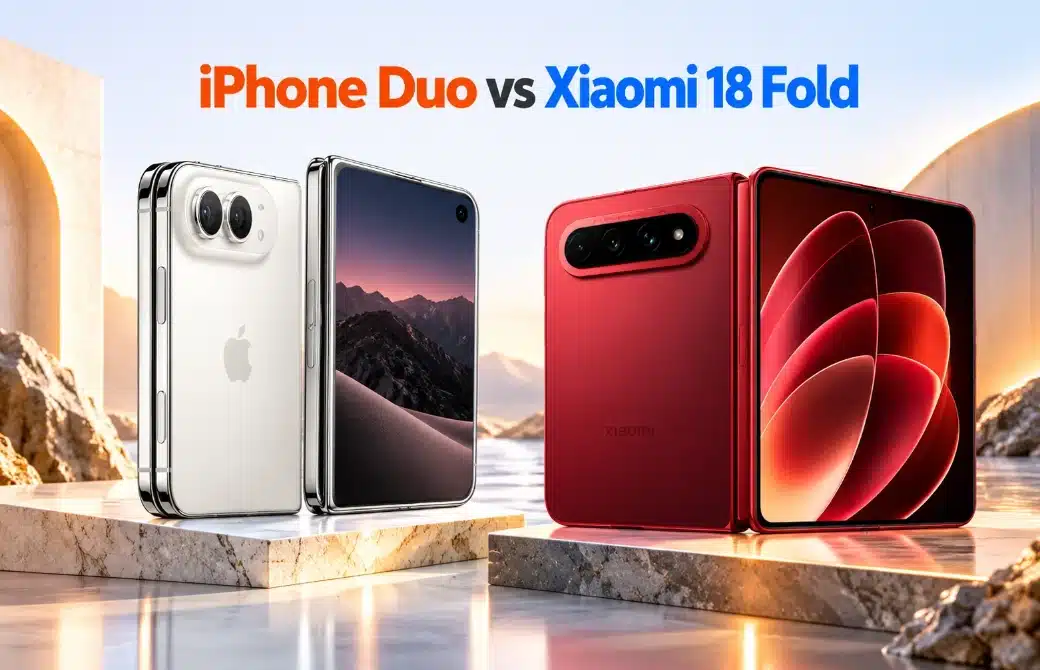
The battle between foldable phones is no longer just about making a screen bend. The real battle is about what happens after you open it. Apple’s first foldable phone, the iPhone Duo, is refined. It turns into a mini iPad with a 7.6-inch display and smooth transition animations. Moreover, its nano-textured inner screen also makes reflections and the crease less distracting.
Then again, Xiaomi takes a different path! It’s a 219g passport-style foldable that packs a huge 6,000mAh battery, a 200MP Leica camera, and multitasking for up to eight active app windows. Notably, Xiaomi has also kept the body thinner and lighter.
But both have clear compromises. The iPhone Duo lacks a dedicated telephoto camera and battery capacity. Meanwhile, the Xiaomi 18 Fold lacks stylus support and has display and heat-management concerns.
So, which foldable actually achieves the best balance? Let’s break it down!
iPhone Duo vs. 18 Fold: Notable Differences at a Glance
| Key Spec | Apple iPhone Duo | Xiaomi 18 Fold |
| Folded Weight | 254g | 219g |
| Folded Thickness | 11.3mm | 10.7mm |
| Inner Display | 7.6″ LTPO OLED, 120Hz | 7.58″ LTPO AMOLED, 120Hz |
| Peak Brightness | 3,000 nits | 4,000 nits |
| Display Finish | Nano-texture + anti-reflective | Standard glass |
| Crease | Very subtle, as low as 0.15mm | ~98% visually reduced |
| Cover Display | 5.4″ OLED, 120Hz | 5.38″ AMOLED, 120Hz |
| Processor | Apple A20 Pro, 2nm | XRing O3, 3nm |
| RAM / Storage | 12GB / 256GB–2TB (LPDDR5X) | 12GB–16GB / 256GB–1TB (LPDDR6 for the upper variant) |
| Rear Cameras | 48MP + 48MP | 200MP + 50MP telephoto + 50MP |
| Optical Zoom | No dedicated telephoto | 3x telephoto |
| Video | 4K up to 120fps, ProRes, Dolby Vision | 8K@24fps, 4K@60fps |
| Battery | — | 6,000mAh Si/C |
| Wireless Charging | 25W | 50W |
| Multitasking | 2 apps side-by-side | Up to 6 apps + 2 floating windows |
| Stylus | Apple Pencil support | No |
| SIM | eSIM only | Dual Nano-SIM |
| Water Resistance | IP68, up to 6m/30 min | IP58/IP59, up to 1m/30 min |
| Build | Titanium + Ceramic Shield 2 | Glass + aluminum |
| Speakers | Stereo | Stereo + Dolby Atmos |
| Connectivity Extras | Satellite, UWB Gen 2, DisplayPort | IR blaster, UWB, OTG |
First & Most Importantly: The Big Difference
The first thing you notice about a foldable is not its processor or camera. It is how it feels in your hand and pocket. That is where the iPhone Duo and Xiaomi 18 Fold take very different approaches.
“Apple Wants You to Notice the Engineering; Xiaomi Wants You to Forget the Fold!”
Apple focuses more on materials, hinge feel, and overall refinement. Xiaomi focuses on keeping its foldable device light and easy to carry.
iPhone Duo: Built to Feel Like a Precision Device
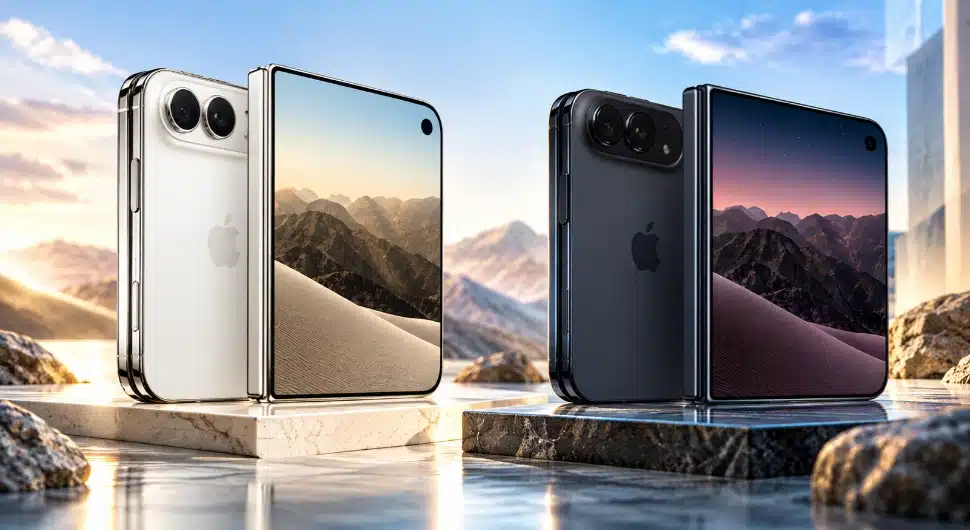
The Apple iPhone Duo weighs 254g, noticeably heavier than the 18 Fold. Yet Apple keeps the unfolded body impressively thin at just 5.2mm. The titanium frame and hinge enhance its solid feel. Meanwhile, Ceramic Shield 2 provides extra protection for the outer display.
The hinge is another part that Apple wants you to notice for its look. Opening or closing the Duo comes with smooth animation and a satisfying magnetic “thud.” It feels less like folding a screen and more like operating a carefully engineered device.
Apple also gives the Duo an IP68 rating, with resistance to immersion in up to 6 meters of water for 30 minutes. That is a notable advantage for everyday durability.
Then there is the inner display. Its nano-texture finish diffuses reflections and makes the creases less distracting. For reading, watching videos, or working near bright windows, this can make the large screen feel more comfortable.
Xiaomi 18 Fold: Make the Foldable Disappear
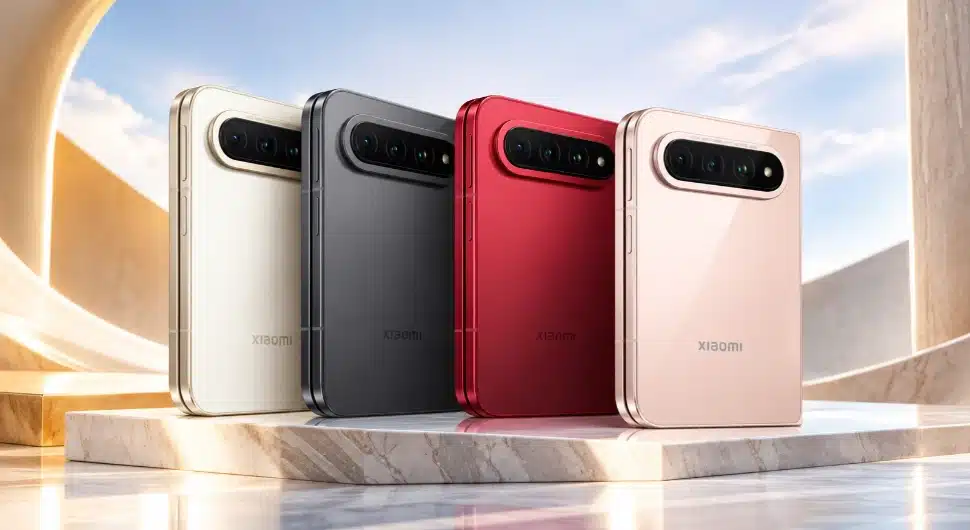
Xiaomi takes the exact opposite approach. At 219g, the Xiaomi 18 Fold is 35g lighter than the Duo. That is a meaningful difference when you carry the phone all day. It is also slightly thinner when unfolded at 5.0mm and measures just 10.7mm when folded.
Its passport-style shape gives the phone a wide, compact look when closed. Despite carrying a large foldable display, it can be surprisingly easy to slip into a pocket. The aluminum frame and glass back keep the construction solid without adding Apple’s titanium weight.
Xiaomi also gives the 18 Fold IP58/IP59 protection, including resistance to high-pressure water jets and immersion up to 1 meter for 30 minutes. The crease is also shallow and difficult to notice on lighter backgrounds.
However, Xiaomi does not use the same nano-texture and anti-reflective treatment as Apple. So fingerprints and reflections can become more noticeable, particularly under bright light.
Other Key Differences to Notice
The biggest differences are not limited to size or weight. From display quality to multitasking, the iPhone Duo and Xiaomi 18 Fold take surprisingly different paths to make their foldable experience useful.
Pocket Test: Which One Feels Like a Phone?
The iPhone Duo has a 5.4-inch cover display with a sharp 460ppi pixel density and a smooth 120Hz refresh rate. Its narrow, iPhone-like shape makes it comfortable for quick tasks. You can check messages, answer calls, browse notifications, or use essential apps without opening the phone.
However, there is a trade-off! At 254g, the Duo is noticeably heavier in your pocket and hand. Its 11.3mm folded thickness also makes it feel heavier.
In contrast, the Xiaomi 18 Fold features a 5.38-inch cover display and a 120Hz refresh rate. So the basic cover screen experience is similar to Duo’s. The bigger advantage is weight.
At just 219g, the Xiaomi is 35g lighter than the Duo and about the same weight as a regular smartphone. It is also thinner when folded at 10.7mm. Surprisingly, that makes the 18 Fold feel closer to carrying a regular smartphone.
So, if your priority is quick everyday use and a familiar mini iPad experience, the Duo has an edge. But for on-the-go comfort and portability, the Xiaomi 18 Fold clearly wins.
The Crease Battle: Can You Actually See It?
The Duo uses a nano-texture finish on its 7.6-inch inner display. This matte surface heavily diffuses reflections. As a result, the crease becomes harder to notice during normal use. This matters particularly when you read or watch content under harsh lighting. Bright reflections do not bounce back as strongly from the screen. So, the display stays easier on the eyes.
But remember, the crease is still there, even at 0.15mm. But the nano-texture surface makes it less distracting. You are more likely to focus on the content than the fold.
Clear note: iPhone Duo’s matte finish makes the crease less distracting!
On the other hand, the Xiaomi 18 Fold takes a different route. Its crease is already very shallow and reportedly reduced by around 98% visually. On light backgrounds, it can be surprisingly difficult to notice. That gives the 18 Fold a cleaner look when the screen is fully open.
However, Xiaomi does not add a nano-texture treatment. The glossy surface can show more fingerprints and reflections, especially under bright lights.
So, Xiaomi gets very close to hiding the physical crease. Apple goes a step further by making the screen surface itself less reflective.
Multitasking: Most Important Differential Section
The iPhone Duo runs iOS 27 and supports two apps side by side. In landscape mode, you can use both apps at the same time. For example, you can keep a browser open beside a note-taking app or watch a video while checking messages.
Apple has also redesigned parts of iOS around the Duo’s larger display. Apps can adapt to the unusual screen shape, so the interface feels more natural when the phone is unfolded.
>> But there is a clear limit. You mainly get a two-app workflow.
The Xiaomi 18 Fold takes a much more aggressive approach. It can keep up to 6 apps running at the same time. You can also add 2 floating windows, giving you up to 8 active app experiences on the large inner screen.
>> That changes how you can use the foldable as a multi-tasking companion.
You can also resize windows as needed. A four-finger swipe-in lets you quickly view active apps. You can also reorder apps and jump directly between them. So, instead of simply putting two apps side by side, the 18 Fold gives you something closer to a small mobile workstation.
Software: Where the Real Battle Happens!
A foldable can have an amazing screen, but the software decides what you can actually do with it. This is where the iPhone Duo and Xiaomi 18 Fold feel very different.
The iPhone Duo runs iOS 27, but this is not simply regular iOS stretched across a larger screen. Apple has changed parts of the interface around the foldable hardware.
Even small details stand out. The opening and closing animations are custom. The interface uses more of the display’s corners. Wi-Fi and network indicators have also been redesigned for the Duo’s unusual shape. You can check the full Apple iPhone Duo review for more details.
These changes may sound minor. They are not. Together, they make the fold feel more connected to the software. Apple’s own apps can also take advantage of the larger inner display. The Duo can shift from a normal iPhone experience to a mini iPad-like experience on the iPad Mini 7 without feeling like two completely separate devices.
On the other hand, the Xiaomi 18 Fold runs Android 17 with HyperOS 4. Its approach is much more flexible. You can resize app windows, use floating windows, and arrange apps in different ways. The software gives you more freedom to decide how the large display should work for you.
This fits perfectly with Xiaomi’s aggressive multitasking system. You are not limited to a simple two-app layout. You can keep several apps active and move between them quickly. So, while Apple’s software feels more controlled, Xiaomi gives you more room to experiment.
Performance: Two Very Different Approaches
The iPhone Duo uses Apple’s A20 Pro, built on a 2nm process. It has a six-core CPU and a seven-core GPU, backed by dedicated Neural Accelerators and a dual 16-core Neural Engine.
The numbers may look smaller beside Xiaomi’s chip. But Apple’s focus is not simply on core count. The Neural Engine handles AI workloads, while the expanded cooling system helps the A20 Pro maintain performance during demanding tasks. This approach fits Apple’s broader hardware-and-software integration.
The Xiaomi 18 Fold takes a more aggressive route with the XRing O3. It uses a 3nm process and packs a 10-core CPU with speeds up to 4.35 GHz. It also comes with the Arm G2-Ultra NX MC16 GPU, a 16-core GPU. Xiaomi claims up to 200 TOPS of tensor performance for AI workloads. The company also highlights faster on-device decoding.
The upper storage variant uses LPDDR6 memory, providing higher bandwidth for demanding workloads and heavy multitasking. This hardware approach matches what we saw earlier. Xiaomi gives the 18 Fold more freedom to run multiple apps simultaneously.
As a clear note, the iPhone Duo and Xiaomi 18 Fold are not chasing performance in exactly the same way. The raw specifications make the Xiaomi XRing O3 look more aggressive. But the A20 Pro takes a more controlled approach.
Battery: Is There a Whole New Story?
The Xiaomi 18 Fold packs a 6000mAh silicon-carbon battery. That is a serious capacity for a foldable this thin. It also supports 67W wired charging and 50W wireless charging. So you get both a large battery and fast-charging options.
There is another useful feature. The 18 Fold supports reverse-wired charging. You can use the phone to provide power to another compatible device when needed.
Apple takes a different approach with the iPhone Duo. The phone uses a Li-Ion battery and prioritizes charging speed over battery capacity. The Duo can reach 50% charge in around 20 minutes with compatible wired charging. It also supports 25W MagSafe and Qi2 wireless charging, reaching 50% in around 30 minutes.
That makes quick top-ups convenient. If your battery is getting low before heading out, a short charging session can give you a useful boost. However, Apple does not match Xiaomi’s battery capacity or charging speeds on paper.
For long on-the-go use, heavy gaming, frequent streaming, and power users, the Xiaomi 18 Fold has the clear advantage.
Security & Unlocking: Touch ID vs Face Unlock
The iPhone Duo uses Touch ID built into the side button. This makes sense for a foldable because the sensor stays easy to reach, whether the phone is open or closed.
When the Duo is folded, you can simply use the side button to unlock it. The fingerprint interaction feels like part of the normal power-button action. This can be particularly useful when you are on the go. You do not need to look directly at the screen to unlock the phone.
Conversely, the Xiaomi 18 Fold offers face unlock along with a side-mounted fingerprint sensor. That gives you more choice. You can use face unlock when the phone is in front of you. Or, you can use the side fingerprint sensor when you prefer a physical touch. This flexibility can make everyday unlocking faster in different situations.
But There Is a Catch
Every foldable has a trade-off. The Xiaomi 18 Fold pushes hardware and multitasking further. Meanwhile, the iPhone Duo brings Apple’s first attempt at a foldable. That difference creates some clear concerns.
“Xiaomi’s Heat Problem vs Apple’s First-Generation Risk”
The Xiaomi 18 Fold packs a lot of power into a very thin body. Its XRing O3 chip, large battery, and demanding multitasking features can push the hardware to its limits.
However, heat distribution and dissipation remain a concern. The thin, foldable body leaves less room for cooling. Also, some user reports suggest that 18 Fold may not spread heat as effectively as expected. This matters more during long gaming sessions or heavy multitasking. Heat can affect sustained performance and may also raise questions about long-term hardware health.
The iPhone Duo has a different problem. It is Apple’s first foldable with a 2nm processor, so some compromises are almost unavoidable. Apple has refined the hardware and software experience, but first-generation products can still have rough edges.
At 254g, the Duo is heavier to keep in a pocket. That makes it less comfortable for long-term on-the-go use. Its camera setup also lacks a dedicated telephoto lens. This limits its zoom flexibility compared to Xiaomi’s 50MP telephoto camera.
So Which Foldable Gets the Formula Right?
The iPhone Duo feels like Apple’s attempt to turn the iPhone into a pocket-sized tablet. The Xiaomi 18 Fold takes a more aggressive approach.
So, which one gets the formula right?
Pick the iPhone Duo if You Want a Polished Everyday Experience!
The iPhone Duo makes more sense if you already use Apple products and want a foldable that feels natural from day one. Its iOS 27 experience focuses on smooth animations, strong app optimization, and close integration with the Apple ecosystem.
The Duo also has a major advantage for people who care about build quality and screen comfort. Its titanium body, Ceramic Shield protection, IP68 rating, and nano-texture inner display give it a premium feel. In particular, the matte inner screen can be useful when you often use your phone outdoors or under strong lighting.
Pick the Xiaomi 18 Fold if You Want More Freedom!
The Xiaomi 18 Fold is the stronger choice for users who want to get more out of the hardware. At just 219g, it is much lighter than the Duo. The 6000mAh battery is also a major advantage for long days, gaming, streaming, and heavy multitasking. Its 67W wired and 50W wireless charging add even more convenience.
Then there are the cameras. Xiaomi gives you a 200MP main camera, a 50MP telephoto, and a 50MP ultrawide. Multitasking is another clear win. You can run up to six apps with two floating windows, giving you up to eight active app experiences. You can resize windows, switch between apps quickly, and arrange your workspace to suit your needs.
The Final Choice
So, there is no single winner for everyone.
- Choose the iPhone Duo for a refined, premium, ecosystem-focused foldable experience.
- Choose the Xiaomi 18 Fold for maximum hardware value, battery endurance, and multitasking freedom.
Surprisingly, that is what makes this comparison interesting. Apple does not win simply because it is Apple. Xiaomi does not win simply because it offers more specifications.
>> Simple Catch: The better foldable is the one that matches what you actually do with your phone every day!
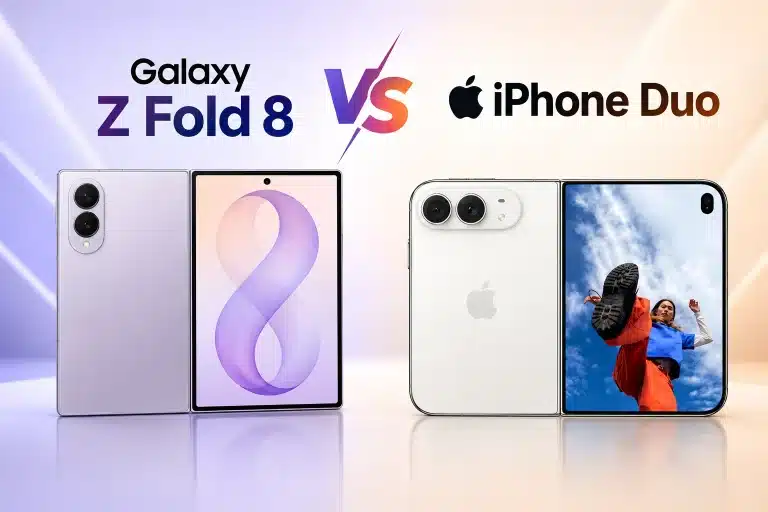
And if you are also comparing Apple with Samsung, it is worth looking beyond these two models. A detailed iPhone Duo vs Samsung Galaxy Z Fold 8 Ultra comparison can show how Apple’s first foldable compares to Samsung‘s more established foldable approach. Likewise, comparing the Galaxy Z Fold 8 vs iPhone Duo can help if your main choice comes down to Apple vs. Samsung.